Tops Paid App Rankings Amid Surge in Single-Person Households
Emergency Alerts Sent If No Daily Check-In
App Name May Change from 'Jugeonni' to 'Are You Alive'
The smartphone application "Jugeonni" (Slumber), developed in response to the rising number of single-person households in China, is receiving significant attention. With its primary feature of checking on users' well-being, it has become particularly popular among the elderly and those living alone.
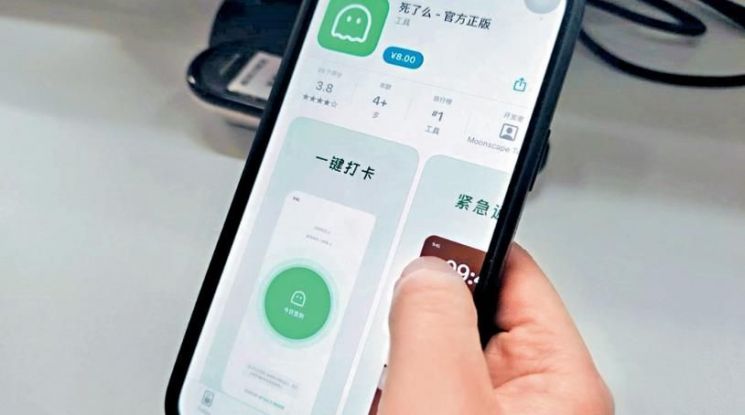
According to Hong Kong's Sing Tao Daily and China's state-run Global Times on January 12, the "Jugeonni" app recently ranked first among paid apps on the Apple App Store.
The structure of the app is simple. Users are required to check in daily by pressing the "Check-in" button in the center of the app, effectively reporting their survival. If a user fails to check in for two consecutive days, an email alert is automatically sent to a designated emergency contact on the following day.
The app is priced at 8 yuan (approximately 1,700 won). Although it was initially distributed for free and later saw a price increase, recent reports indicate that the number of downloads has surged more than 100-fold.
One of the app's developers, Mr. Guo, stated, "The development team originally consisted of three people, all born after 1995," adding, "We plan to transfer a 10% stake in the company for 1 million yuan (about 210 million won)." The team reportedly invested about 1,000 yuan (around 200,000 won) in developing the app and has already turned a profit.
The development team plans to expand notification features and add a message-leaving function, aiming to make the app system even more user-friendly for the elderly. They also mentioned that they are considering changing the app's name.
Previously, as the app gained attention, there was heated debate in China regarding the app's direct name, "Jugeonni," which literally means "Are you dead?" While the explicit reference to death piqued curiosity and boosted downloads, critics argued that the term was offensive and clashed with Chinese cultural sensitivities that avoid ominous expressions. As negative feedback continued, the development team announced they are considering changing the app's name to "Saraiitni," meaning "Are you alive?"
With China's low birth rate and rapidly aging population, projections suggest that the number of single-person households could reach up to 200 million by 2030. As the number of single-person households in China increases rapidly, there is growing demand for measures to ensure their safety.
Hu Xijin, former editor-in-chief of the state-run Global Times, commented about the app on Weibo, saying, "It is truly good, and I think it will help many lonely elderly people living alone."
Some have suggested that such apps should go beyond simple check-in functions and expand into a professional safety network connected to local communities or emergency response systems.
© The Asia Business Daily(www.asiae.co.kr). All rights reserved.
![From Hostess to Organ Seller to High Society... The Grotesque Scam of a "Human Counterfeit" Shaking the Korean Psyche [Slate]](https://cwcontent.asiae.co.kr/asiaresize/183/2026021902243444107_1771435474.jpg)
















