Weekly Trading Closes at 1,468.4 Won; Surpasses 1,470 Won Intraday
Driven by Yen Weakness and Foreign Investors Selling Korean Stocks
The USD-KRW exchange rate has risen for eight consecutive trading days, showing a sharp upward trend again at the start of the new year. For the first time since the foreign exchange authorities intervened at the end of last year, the rate has surpassed the 1,460 won level, breaking through 1,470 won during intraday trading and approaching the 1,480 won mark.
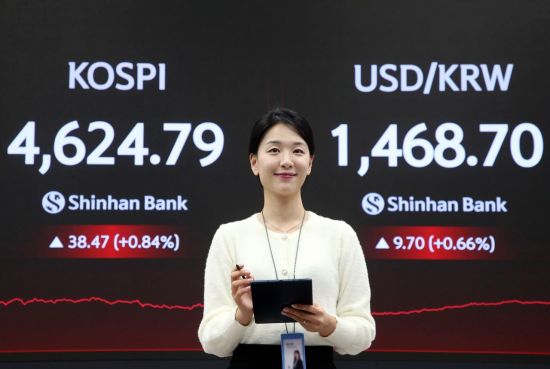 On the 12th, the USD-KRW exchange rate is displayed on the status board in the Shinhan Bank dealing room in Jung-gu, Seoul. Provided by Shinhan Bank
On January 12, the weekly closing price (as of 3:30 p.m.) of the USD-KRW exchange rate in the Seoul foreign exchange market was 1,468.4 won, up 10.8 won from the previous trading day. This is the first time in about three weeks that the USD-KRW exchange rate has exceeded 1,460 won since the authorities intervened on December 24 last year.
The exchange rate opened at 1,461.3 won, up 3.7 won from the previous trading day, dropped to 1,457 won around 9:40 a.m., but gradually expanded its gains. By around 3 p.m., it had surpassed 1,470 won during trading.
Previously, on December 24 last year, the USD-KRW exchange rate had climbed to 1,484.9 won, but after strong intervention from the authorities, it dropped to 1,429.8 won on December 29. However, since December 30 last year, it has continued to rise consecutively.
On this day, the exchange rate moved in tandem with the weakening of the Japanese yen. Over the past weekend, news that Japanese Prime Minister Sanae Takaichi might dissolve the parliament and call a snap general election increased pressure on the yen. Expectations that Prime Minister Takaichi would strengthen aggressive fiscal policies, as she has pledged, appear to have fueled yen-selling sentiment. The yen-dollar exchange rate rose to 158.199 yen during trading, the highest level in a year since January 10 last year (158.877 yen).
The net selling of stocks worth 351 billion won by foreign investors in the domestic stock market also appears to have had an impact. In addition, from a supply and demand perspective, continued pressure on the exchange rate is attributed to individual investors buying dollars at lower prices and exporters delaying dollar sales.
The strength of the dollar eased somewhat compared to the previous trading day. The dollar index (DXY), which measures the value of the dollar against the currencies of six major countries, rose to 99.243 around 9 a.m. but has since fallen below the 99 level. This appears to be due to the U.S. Department of Justice issuing a grand jury subpoena related to renovations at the Federal Reserve building, which has been perceived as a direct confrontation between the Trump administration and the Fed, thereby putting downward pressure on the dollar. Jerome Powell, Chair of the Fed, expressed concern over the "unprecedented pressure," warning of threats to the central bank's independence.
© The Asia Business Daily(www.asiae.co.kr). All rights reserved.
![Clutching a Stolen Dior Bag, Saying "I Hate Being Poor but Real"... The Grotesque Con of a "Human Knockoff" [Slate]](https://cwcontent.asiae.co.kr/asiaresize/183/2026021902243444107_1771435474.jpg)
















