Switching Teacher Staffing Calculation to Number of Classes
Calls for 20-Student Cap per Class and Other Reforms
On January 12, seven educational organizations, including the three major teacher groups-the Korean Federation of Teachers' Associations, Korean Teachers and Education Workers Union, and Teachers' Labor Union Federation-criticized the government's policy of reducing teacher staffing.
That morning, they held a press conference in front of the Ministry of the Interior and Safety at the Government Sejong Complex, stating, "The justification that the number of teachers should be reduced simply because the number of students is declining is a typical example of out-of-touch bureaucracy that ignores the realities of the educational field and amounts to a declaration of abandoning public education."
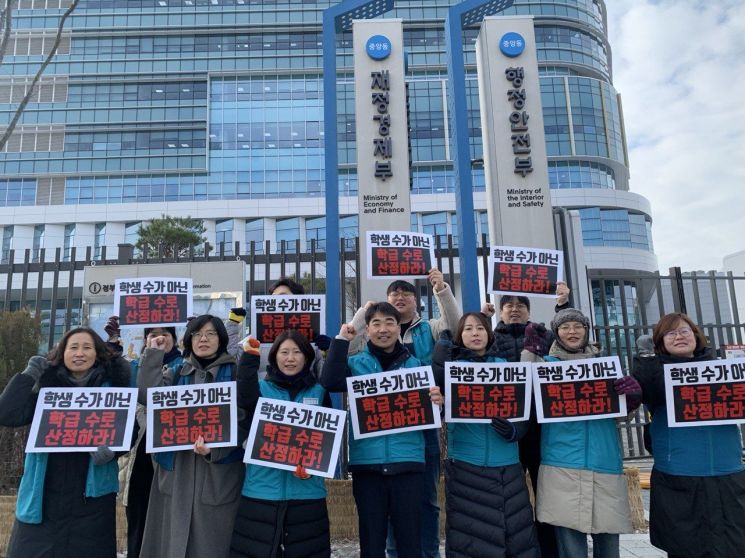 On the 12th, seven educational organizations (Korean Teachers and Education Workers Union, Korean Federation of Teachers' Associations, Teachers' Labor Union Federation, Practical Education Teachers' Association, New School Network, National Education University Students' Union, and National Council of University Presidents for Teacher Education) held a press conference in front of the Ministry of the Interior and Safety at the Government Sejong Complex to urge the securing of appropriate teacher staffing. They called for the government to stop its mechanical policy of reducing teacher staffing and to improve systems to ensure adequate teacher staffing. Korean Teachers and Education Workers Union
Kang Juho, President of the Korean Federation of Teachers' Associations, pointed out, "Compared to 2012, the number of multicultural students has increased fourfold, the number of students requiring special education has grown by 1.4 times, and the proportion of students falling below basic academic standards has nearly tripled in the past ten years." He criticized the government for "cutting staffing based solely on mechanical economic logic while ignoring these educational needs." He also stated, "In 2024, there are 8,661 teacher positions unfilled nationwide, resulting in critical gaps, and the number of temporary teachers has exceeded 60,000, creating a distorted employment structure that seriously undermines the stability of the educational environment."
Park Younghwan, President of the Korean Teachers and Education Workers Union, noted, "Under the high school credit system, a single teacher is responsible for teaching three to four subjects, and overcrowded classes with more than 26 students account for 56% of middle schools and 49.3% of high schools." He added, "In rural and fishing communities, the decrease in teachers has led to 'mismatched teachers' who teach subjects outside their expertise and 'itinerant teachers' who move between multiple schools." He emphasized the need to "legislate a 'basic staffing system' to secure essential staffing for small schools and an 'additional staffing system' that takes policy needs into account."
On this day, the seven organizations demanded that the government: ▲ immediately abolish the mechanical teacher staffing reduction plan; ▲ switch the teacher staffing calculation standard to the number of classes; ▲ introduce a cap of 20 students per class without delay; and ▲ legislate a 'basic staffing system' for small schools and an 'additional staffing system' that considers policy needs. They also delivered a petition with 46,385 signatures to the Ministry of the Interior and Safety, calling for the securing of appropriate teacher staffing.
© The Asia Business Daily(www.asiae.co.kr). All rights reserved.

















