Acceleration on the Human Body Predicted at 20G
Jung Junho: "A Comprehensive and Objective Investigation Is Needed"
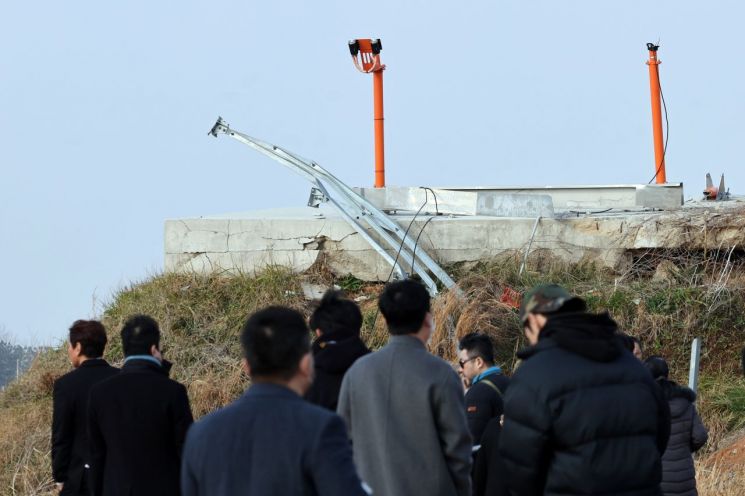 On December 29 last year, marking the first anniversary of the Jeju Air passenger plane disaster on December 29, families of the victims are seen inspecting the concrete embankment at the site of the Muan International Airport disaster. Photo by Yonhap News
It has been analyzed that the aircraft involved in the 12·29 Jeju Air passenger plane disaster at Muan Airport collided with the embankment at an average speed of 232 km/h.
On January 12, Assemblyman Jung Junho of the Democratic Party of Korea (representing Buk-gu Gap, Gwangju), a member of the National Assembly's special investigation committee on the passenger plane disaster, released analysis data titled "Aircraft Impact Acceleration Review" submitted by the Aviation and Railway Accident Investigation Board (ARAIB). According to the data, the average speed of the aircraft was analyzed as follows: ▲ 374 km/h at the fuselage landing point (point a), ▲ 374 km/h at the start of runway friction (point s), ▲ 324 km/h at point b, ▲ 280 km/h just before impact (point e), and ▲ 232 km/h at the point of collision (point c).
Regarding the timing at each point, if the fuselage landing point (point a) is set as 0 seconds, point s is approximately 15 seconds, point b is just after 20 seconds, point e is just after 25 seconds, and point c is just before 30 seconds. The ARAIB analyzed the speeds using video analysis and other methods.
Through the case-1 evaluation, the ARAIB predicted that the acceleration exerted on the human body at the moment of collision was at least 20G or higher. This result was based on the assumption that the ratio of the effective mass of the ground to the mass of the aircraft was at least 0.5, and that the duration of the collision was up to 0.1 seconds.
In the case-2 evaluation, the acceleration exerted on the human body just before the collision was predicted to be in the range of 40 to 60G. This was based on the assumption that the ratio of the speed just before and just after the collision was between 0.1 and 0.4, with the collision duration set at 0.1 seconds.
Assemblyman Jung Junho stated, "The interpretation of the data is a matter for experts, and a comprehensive analysis is required to determine the cause of the accident," adding, "We are disclosing some of the objective findings regarding the collision speed and acceleration at the time of the accident to uphold the public's right to know."
He also emphasized, "The truth of the disaster must be thoroughly revealed through the National Assembly investigation and subsequent comprehensive and objective accident investigations."
© The Asia Business Daily(www.asiae.co.kr). All rights reserved.
!["The Woman Who Threw Herself into the Water Clutching a Stolen Dior Bag"...A Grotesque Success Story That Shakes the Korean Psyche [Slate]](https://cwcontent.asiae.co.kr/asiaresize/183/2026021902243444107_1771435474.jpg)
















