Uncertainty Grows Over Achieving 'AI Technology Self-Reliance'
Government: "Evaluation Will Be Left to the Committee"... Evaluation Period Extended
Potential Impact of Licensing Fee Increases Must Be Considered
As controversies continue over the use of foreign technology by companies participating in the government-led "independent AI foundation model" project, there is ongoing debate about whether the project can truly achieve its goal of AI technology self-sufficiency.
With the controversy over the use of Chinese models intensifying, critics argue that the government's reliance on evaluation committee members without making any public statement is not only an evasion of responsibility, but could also lead to future disputes over fairness as the first round of eliminations is set to be decided soon.
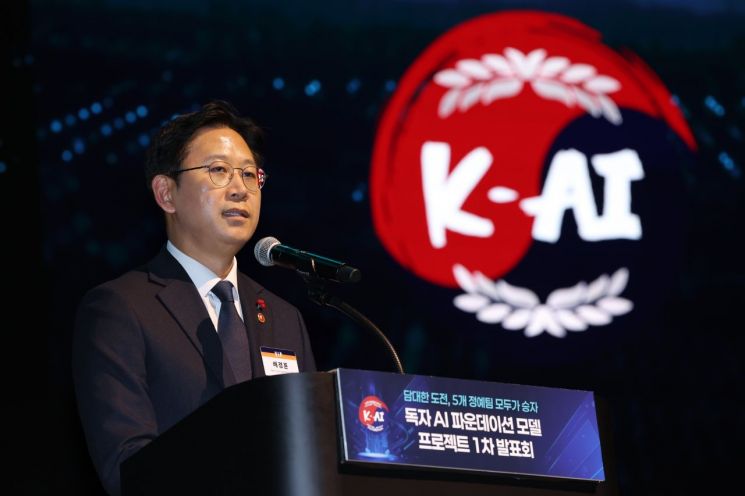
On January 12, the Ministry of Science and ICT announced that it would extend the operation of the AI model site, which was made available to the evaluation panel for the five consortia participating in the independent AI foundation model project, from the originally planned deadline of 6 p.m. on January 9 to midnight on January 11. As a result, the site, which allows the expert evaluation panel to review each consortium's model, will be accessible for an additional 54 hours. The government stated, "The review will be left to the expert evaluation committee," but by extending the model evaluation period, it appears to be grappling with the situation.
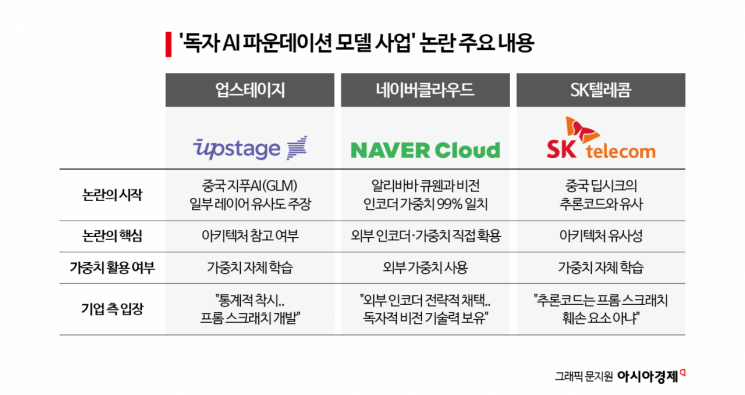
The Ministry of Science and ICT has drawn a line, saying, "This has nothing to do with the recent controversy over the independent technological capabilities of certain consortia." However, the government is also in a difficult position as three out of the five elite teams-Upstage, Naver Cloud, and SK Telecom-are embroiled in controversy over their use of foreign open-source models, with the evaluation deadline fast approaching. In particular, this project is a mid- to long-term initiative running through 2027, and is expected to require a budget of several hundred billion won for NVIDIA GPUs, data support, and more.
Within the industry, while the controversy over the use of Chinese models is growing more intense, the government has yet to issue any specific guidelines regarding the issue. Instead, it maintains the principle of respecting the judgment of the evaluation committee, which is composed of experts, relying on their conscience and expertise. A Ministry of Science and ICT official said, "We provided the expert evaluation forms to the committee members in advance and asked them to conduct a multifaceted review," adding, "If the government intervenes in the evaluation, there would be no reason to have expert committee members in the first place."
The project guidelines define an independent AI foundation model as a domestically developed model that is designed and pre-trained from scratch, rather than a derivative model developed by fine-tuning a foreign model, and with no licensing issues related to third-party models.
Accordingly, there is a need to closely examine the license regulations of the foreign AI models used by companies. If foreign AI technology has been partially adopted in the model development process, at a minimum, the model must be free from interference by the overseas AI company that provided the original technology. If the overseas AI company suddenly raises usage fees or blocks usage altogether, it would be difficult to achieve the project's goal of establishing AI technological sovereignty.
In this context, Upstage and SK Telecom used "inference code" from Chinese models, while Naver Cloud used a vision encoder and weights. Upstage and SK Telecom argue that inference code is free from licensing restrictions. Naver Cloud stated, "The Qwen2.5 vision encoder we used is open source under the Apache 2.0 license, and the rights to the version we are using cannot be unilaterally revoked or retroactively applied," adding, "Replacing the encoder is possible through internalization."
As competition among participating companies intensifies, the situation is devolving into a mudslinging match. A representative from one consortium strongly criticized, "According to global standards for 'from scratch' development, the Naver Cloud consortium should be disqualified for misconduct, yet the Ministry of Science and ICT is just standing by without making any statement." Another representative expressed concern, saying, "This is just the beginning of the controversy, and it cannot be ruled out that none of the five consortia will be free from it."
An AI company official, speaking on condition of anonymity, commented, "Currently, Korea's national AI is like repeatedly redecorating a building constructed in China," and suggested, "Ultimately, if the government truly wants an independent AI, it should consider, albeit belatedly, designing the architecture itself from scratch."
© The Asia Business Daily(www.asiae.co.kr). All rights reserved.
![Clutching a Stolen Dior Bag, Saying "I Hate Being Poor but Real"... The Grotesque Con of a "Human Knockoff" [Slate]](https://cwcontent.asiae.co.kr/asiaresize/183/2026021902243444107_1771435474.jpg)


















