Climatic Solution: "Limitations of Transmission-Centered Approach
Local Communities Must Lead in Electricity Production, Consumption, and Trading"
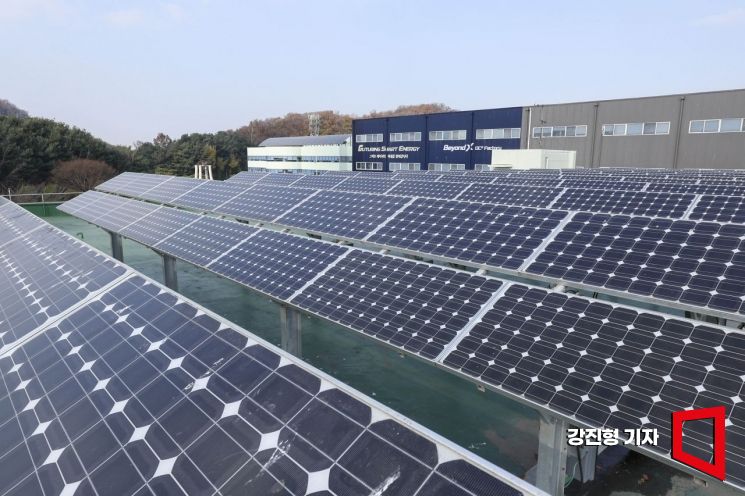 Solar panels installed at LS Electric Cheonan DC Factory in Chungnam. 2025.11.20 Photo by Kang Jinhyung
There are concerns that achieving the government’s goal of “100GW of renewable energy by 2030” will be difficult under the current centrally designed electricity market structure. It is argued that the electricity market should be transformed to allow locally produced electricity to be consumed and traded within the region.
Climate Solutions, a private think tank specializing in climate and energy, stated in its report released on the 12th, “Power Market Reform for Local-Led Renewable Energy Deployment,” that in order to resolve bottlenecks in renewable energy expansion, it is urgent to move away from the current transmission network-centered approach and shift toward a local-led electricity market where regions directly participate in electricity production, consumption, and trading.
According to the report, to achieve the government’s 2030 renewable energy target of 100GW, the installed capacity, which stood at about 30GW as of 2023, needs to be expanded by more than three times.
However, the expansion of renewable energy has not progressed as quickly as expected due to bottlenecks in the power grid.
Korea Electric Power Corporation (KEPCO) designated 205 substations nationwide as “grid management substations” in 2024 due to grid saturation. In particular, all substations in the Honam and Jeju regions were included. In these areas, connection of new renewable energy generation facilities to the grid is, in principle, restricted until the completion of transmission and substation facilities in 2031.
The government and electricity authorities have presented the expansion of ultra-high-voltage transmission networks as the key solution to grid saturation. Plans have also been announced to shorten the transmission line construction process through a special law for expanding the national backbone power grid.
The report assessed that this approach faces both time and social constraints. It takes an average of nine years to build a single 345kV transmission line, and more than half of the already planned transmission and substation projects are delayed due to opposition from local residents and permitting issues. Therefore, simply expanding the transmission network will not be sufficient to secure the capacity needed to accommodate renewable energy by 2030.
The report pointed out, “If we rely solely on sending electricity produced in the regions back to the Seoul metropolitan area, it will not only take a long time to resolve grid issues, but will also inevitably increase social conflict and cost burdens.”
As an alternative, the report proposed local power purchase agreements (PPAs) and regional flexibility markets as key solutions.
Currently, 99% of renewable energy generation facilities installed in Korea are small-scale facilities under 10MW, most of which are connected to the distribution network. The report highlighted that by establishing a market that allows electricity to be used locally through the distribution network, it is possible to expand renewable energy capacity without large-scale transmission network expansion.
In fact, Paju City is supplying renewable energy to small and medium-sized enterprises at prices lower than private PPAs or KEPCO rates through a local PPA led by the local government.
The report also noted that the current direct PPA system sets strict minimum facility capacity and contract power requirements, which hinder participation by small and medium-sized enterprises and small-scale power producers.
As an alternative, the report suggested allowing an aggregated PPA structure in which multiple generators and multiple consumers can participate, and applying differentiated network charges for electricity produced and consumed within nearby regions to reduce the burden.
Furthermore, the report evaluated that if local governments and regional energy corporations are allowed to participate as renewable energy power suppliers or virtual power plant (VPP) operators, it would be possible to simultaneously achieve renewable energy expansion, strengthen the competitiveness of local industries, and alleviate the burden of electricity costs.
Kim Geonyeong, an attorney at Climate Solutions, stated, “The debate over the power grid is not simply a technical issue, but a structural question of who will lead the energy transition.” He added, “If regions are restricted by grid saturation and the only solution is to expand the transmission network, it will be difficult to achieve renewable energy targets or balanced regional development.” He emphasized, “To simultaneously expand renewable energy, ease the burden on the power grid, and revitalize the local economy, the electricity market structure must be transformed so that regions can directly produce, consume, and trade electricity.”
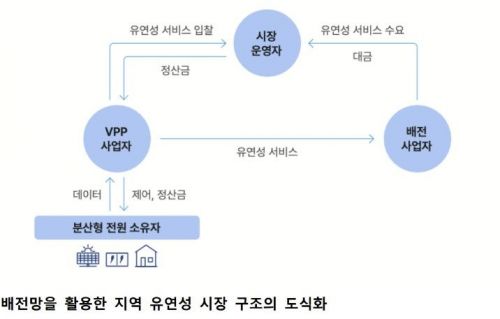
In line with the implementation of the Distributed Energy Act, KEPCO will officially begin its role as a Distribution System Operator (DSO) in November 2024, pushing for a transition to a system where regional power grids are directly managed and operated. To this end, KEPCO is establishing distribution network management principles and mid- to long-term expansion plans, and is also preparing to introduce “regional flexibility services” to address congestion and voltage issues in local power grids.
The regional flexibility market is structured so that VPP operators, who aggregate distributed power sources such as solar power, energy storage systems (ESS), and demand response (DR), can provide “flexibility” as a service by adjusting electricity usage or generation. By utilizing this, it is possible to alleviate power congestion in specific areas without building new transmission lines or substations, making it a notable means to delay or replace large-scale power grid construction.
However, Climate Solutions pointed out that KEPCO’s direct participation as a market operator, given that it owns generation subsidiaries that can participate in the regional flexibility market, undermines the fairness and vitality of the market. There are concerns that if KEPCO sets the market rules and determines trading conditions and counterparties, it could discourage other operators from entering the market.
The report emphasized that for the regional flexibility market to function as a practical alternative, institutional improvements are needed to ensure transparency in market operation and address conflicts of interest.
© The Asia Business Daily(www.asiae.co.kr). All rights reserved.


















