'Ordinary Wage Dispute' Negotiations Set for the Afternoon of January 12
Ongoing Tug-of-War Over Wage Increase Rate
Union: "Ordinary Wage Issue to Be Settled Through Civil Litigation"
The Seoul city bus labor union and management, which have been at odds over a wage increase proposal, will enter last-minute negotiations on January 12. The main issue is how much wages will be raised in accordance with the court's ruling on ordinary wages. If the negotiations break down, the union has announced its intention to go on strike starting tomorrow.
According to the bus industry, the Seoul Regional Labor Relations Commission will hold a post-mediation meeting of the special mediation committee at 3 p.m. on this day regarding the labor dispute of the Seoul City Bus Labor Union, which is affiliated with the Korean Automobile & Transport Workers' Federation. A post-mediation meeting is convened when labor and management fail to reach an agreement even after the official mediation process for a labor dispute has concluded, and the labor commission intervenes to mediate the dispute afterward.
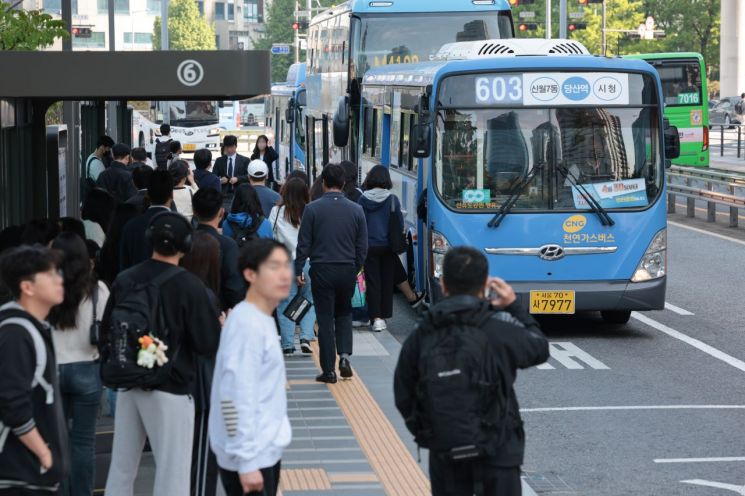 The Seoul city bus labor union and management will enter final negotiations on the 12th. If the negotiations fail, the union plans to start a strike from tomorrow. The photo shows the bus transfer center stop in front of Seoul Station. Photo by Yonhap News Agency
Labor and management have struggled with negotiations on wages and collective bargaining agreements since last year. Even after several rounds of working-level talks in recent days, they have failed to narrow their differences.
The core of the conflict is whether regular bonuses should be included in ordinary wages. In December 2024, the Supreme Court, and in October last year, the Seoul High Court, ruled in the Dong-A Transportation appeal case that bonuses must be recognized as part of ordinary wages. The Dong-A Transportation case began in May 2015, when some Seoul bus workers filed a lawsuit against the company, demanding that bonuses be included in their ordinary wages.
In response, the union argues that since the court recognized bonuses as ordinary wages and accepted the union's position (176 hours) instead of management's (209 hours) regarding the calculation of standard working hours when converting bonuses to base pay, the effective hourly wage increase is 12.85%.
On the other hand, the city of Seoul and management counter that the Dong-A Transportation appeal court only recognized about 45% (844,382,820 won) of the union's claim (1,895,508,651 won), so when converted to a wage increase rate, the appropriate level is only 6-7%. They further argue that if all items the union excluded from its calculation of the wage increase rate, such as annual leave compensation, are included, the actual demand is even higher. Management also stresses fairness, pointing out that the wage increase rates for bus drivers in other metropolitan cities such as Busan, Daegu, and Incheon have remained in the 10% range.
On this day, the union also stated, "The claim by the city of Seoul and management that the union's wage increase demand is excessive is not true, and the issue of ordinary wages has been clearly decided to be resolved through civil litigation, not wage negotiations." The union explained that it intends to separate the issue of ordinary wages from negotiations in order to resolve the matter according to the law and proper procedures, rather than escalating the dispute. The union added, "The city of Seoul and management can fully present their arguments in court and accept the court's judgment."
However, even if negotiations break down on this day, it remains uncertain whether the union will proceed with a full-scale strike. There is negative public opinion about causing inconvenience to citizens while demanding a high wage increase. Moreover, since Seoul city buses operate under a quasi-public system, a significant wage increase would require additional city budget allocations, which could increase the financial burden on citizens.
Previously, the union had also announced strikes in May and November last year but eventually withdrew them. In 2024, an agreement was reached with management after about 11 hours of strike action.
© The Asia Business Daily(www.asiae.co.kr). All rights reserved.
![A Woman Who Jumps Holding a Stolen Dior Bag... The Mind-Shaking, Bizarre Con of a "Human Knockoff" [Slate]](https://cwcontent.asiae.co.kr/asiaresize/183/2026021902243444107_1771435474.jpg)
















