From Disaster Response to Everyday Care
A Resident Safety Net Built Through Technology
How was Hapcheon County able to achieve zero casualties during the record-breaking heavy rainfall in July 2025?
The answer lies in Hapcheon County's smart disaster response system, centered around the Smart Village Broadcasting. This response, which protected the lives of residents in a moment of crisis, clearly demonstrated the strength of the advanced smart disaster response framework that Hapcheon County has been leading nationwide.
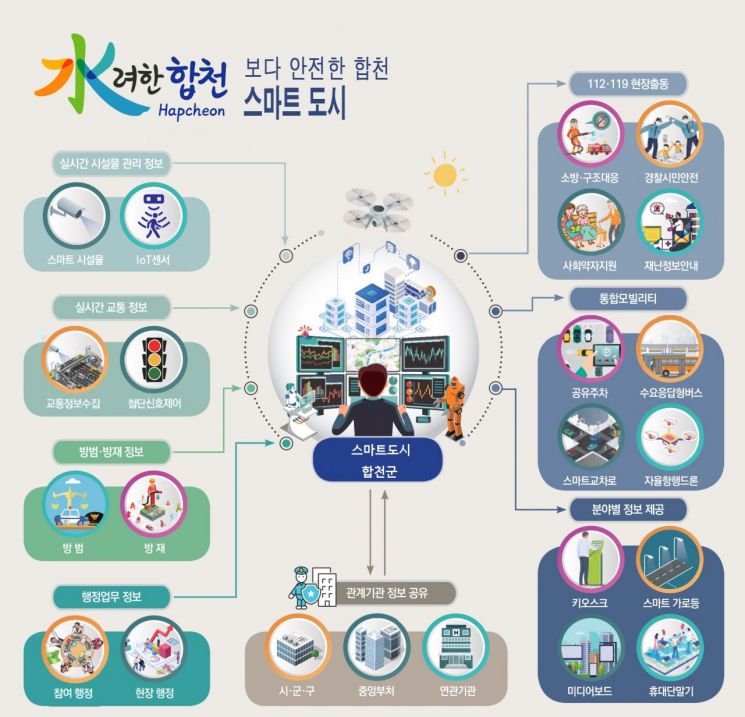
◆ Leading the Nation in Smart Disaster Response
Hapcheon County’s journey toward smart administration began as early as 2001. At that time, the county introduced a remote wireless village broadcasting system that allowed village leaders to make announcements directly via mobile phone, enabling broadcasts from anywhere without visiting the village hall. This system, which delivered messages through speakers installed throughout each village, was a groundbreaking initiative at the time, making Hapcheon County a national pioneer in smart governance.
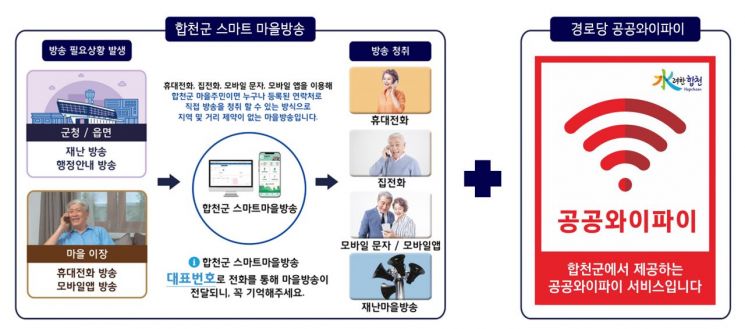
This village broadcasting system evolved once again in 2023. To overcome the limitations of the speaker-based delivery method, the county introduced the Smart Village Broadcasting System. This new system retransmits the same announcements to each resident’s mobile phone after the initial broadcast, ensuring that those indoors, outside, or with hearing difficulties do not miss important information. The system has thus transformed from a simple broadcasting tool into a communication network that leaves no one behind.
◆ 528 Senior Centers Connected by Video: A Solution for a Super-Aged Society
With the fourth-highest aging rate in the country, Hapcheon County faces a serious demographic challenge. In response, the county has proactively prepared for a smart city transition. Beginning in 2022, public Wi-Fi was installed in all 528 senior centers, with full implementation completed in 2023. Building on this, the county launched the Smart Senior Center Project in earnest.
Starting with 50 senior centers in 2024, the county is investing a total of 5 billion won to gradually expand the project through 2027. Notably, from 2024 to January 2026, all 528 senior centers are being connected via a video conferencing system. As a result, each senior center has become more than just a resting place-it now serves as a community hub that communicates in real time with the county government.
Through this system, not only can senior centers communicate with each other, but in the event of a disaster, the county’s Disaster Management Center can connect with all senior centers via video, allowing for direct situation assessment and immediate response. Seniors can check disaster situations in real time using only their smartphones, while the county can monitor conditions on the ground via video for more precise responses. In addition, health care services for seniors, CCTV, and emergency bells have been installed, creating a safety net that connects directly to the police in emergencies. Senior centers are now functioning as “situation rooms in daily life.”
◆ A Smart City Blueprint for All Generations
Hapcheon County’s smart city vision is not limited to the elderly. In the first half of 2026, the county plans to strengthen spatial connections between Hapcheon-eup and major tourist attractions by establishing smart poles, smart parking sharing, and smart lifestyle and tourism kiosks. This strategy aims to revitalize the local economy and enhance resident safety, creating a smart city foundation that both residents and tourists can experience firsthand.
Additionally, in response to wildfires that occurred nationwide in March 2025, the county is preparing to introduce a smart wildfire and fire monitoring system using tethered drones. Given that over 70% of Hapcheon County is forested, this system will enable efficient monitoring of vast areas and significantly enhance initial response capabilities.
Furthermore, in 2026, a smart child care service for children under 13 will be established. By leveraging ICT technology to provide AI-based learning and play services, the county aims to overcome the limitations of educational access in remote areas and simultaneously address child care and educational disparities. This is not merely an expansion of welfare, but a forward-looking investment to create a better environment for raising children.
While public Wi-Fi in all senior centers has laid the foundation for infrastructure, the Smart Village Broadcasting connects residents through “sound,” and the Smart Senior Center Project connects them through “video.” With the addition of child care and tourism and lifestyle smart solutions, Hapcheon County is evolving into a multidimensional smart city that encompasses all ages and sectors.
Jung Cheolsoo, Director of Administration and Welfare, stated, “The smart city that Hapcheon County envisions is not about showcasing technology, but about choosing to respond more quickly to disasters and to care for residents more closely in everyday life, while moving further toward the future. We are creating real change that protects and enhances the lives of our residents through a smart city centered on people, not technology.”
© The Asia Business Daily(www.asiae.co.kr). All rights reserved.
!["The Woman Who Threw Herself into the Water Clutching a Stolen Dior Bag"...A Grotesque Success Story That Shakes the Korean Psyche [Slate]](https://cwcontent.asiae.co.kr/asiaresize/183/2026021902243444107_1771435474.jpg)

















