Included in the 52 Top Travel Destinations Worldwide
Korea's First East-West Trail Designed for Backpacking
Full Opening Scheduled for 2027
The Dongseo Trail, a long-distance forest path known as the "Korean Camino de Santiago," has been included in The New York Times' list of recommended travel destinations for 2026.
On January 7 (local time), The New York Times featured the Dongseo Trail in its article "52 Places to Go in 2026."
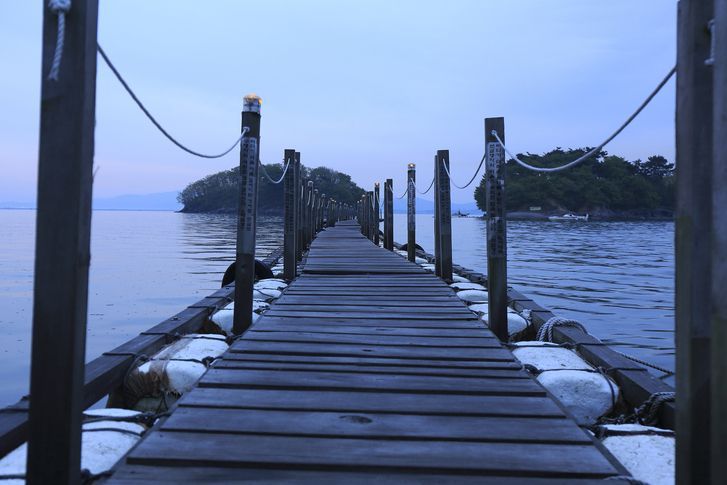

The Dongseo Trail is an 849-kilometer-long forest path that stretches across the Korean Peninsula from Anmyeondo in Taean County, South Chungcheong Province, to Manghyangjeong in Uljin County, North Gyeongsang Province. It consists of a total of 64 sections, including 55 main routes and 9 branch routes, and has been under development by the Korea Forest Service since 2023. In October last year, 17 sections (244 kilometers) were opened on a trial basis. The goal is to complete construction by the end of this year and fully open all sections by 2027.
It is also notable for being the first trail in Korea to be designed specifically for backpacking. Rather than a simple hiking course, it is modeled as a journey where travelers walk with backpacks and camping gear, staying overnight or longer. Unregulated camping is not allowed; accommodation and cooking are permitted only at designated shelters and campsites in each section. Base camp villages have been designated for access to restaurants, lodging, and convenience facilities, and information as well as shelter reservations are available through the "Supnadel-e" platform.
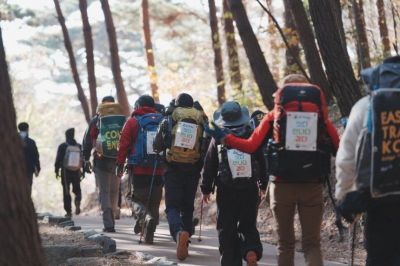
The New York Times introduced the Dongseo Trail as Korea's first east-west long-distance trail, describing it as "a new long-distance trail connecting Korea's hidden gems." The article recommended, "Escape the bustle of Seoul and discover the hidden charms of Korea along the Dongseo Trail."
The New York Times also explained that "the Dongseo Trail connects natural, ecological, and cultural resources that are not widely known even among domestic travelers." The highlighted sections include: the ancient pine forest in Sogwang-ri, Uljin County, home to Korean red pines over 500 years old; Beopjusa Temple's unique wooden pagoda, a UNESCO World Heritage Site; Bonghwa, famous for sweetfish; Hansan in Seocheon, known for traditional ramie fabric production; Hahoe Village in Andong, where Confucian clan society is preserved; and Uljin, renowned for its East Sea snow crab festival.
Other destinations selected by The New York Times this year include Route 66 in the United States, the Himalayas in Nepal, the Canadian Rockies, Nagasaki and Okinawa in Japan, and Yunnan Province in China. In addition, notable events and attractions such as the 250th anniversary of American independence, a total solar eclipse visible in Iceland, and the newly established Museum of Modern Art in Warsaw, Poland, were also highlighted.
© The Asia Business Daily(www.asiae.co.kr). All rights reserved.

![Clutching a Stolen Dior Bag, Saying "I Hate Being Poor but Real"... The Grotesque Con of a "Human Knockoff" [Slate]](https://cwcontent.asiae.co.kr/asiaresize/183/2026021902243444107_1771435474.jpg)

















