Outdoor Cats Prey on 1.5 Billion Birds Annually
Rooted in Free-Roaming Culture... "Indoor Cat Care Should Be Expanded"
In Japan, so-called "outdoor cats" that freely move in and out of homes are reportedly causing serious disruption to the ecosystem.
The Asahi Shimbun reported on January 6 that outdoor cats-which include house cats that go outside, stray cats, and feral cats-hunt approximately 1.5 billion birds and about 240 million mammals across Japan each year.
The prevalence of outdoor cats in Japan is rooted in traditional pet-keeping culture. Yamada Fumio, a visiting professor at Okinawa University, explained, "In the past, there was a perception that cats were pets that required little effort and could be left to roam freely," adding, "That is why many cats are raised in this manner."
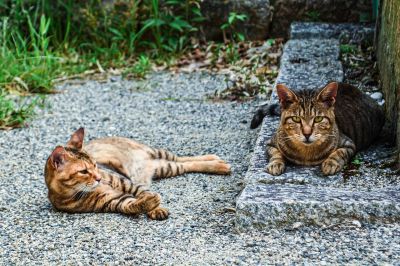
According to a survey conducted in Atsugi City, Kanagawa Prefecture, outdoor cats preyed on 13,200 birds and 2,100 mammals per square kilometer annually. This area is a typical urban environment with a mix of residential and mountainous zones, and when extrapolated to the total area inhabited by cats in Japan, the number reaches approximately 1.5 billion birds.
There have long been assessments that cats act as invasive alien species within native ecosystems. The Smithsonian Migratory Bird Center in the United States has estimated that at least 63 species of birds, mammals, and reptiles have become extinct due to cats.
In Australia, an increasing number of local governments have implemented "cat curfews" in recent years, prohibiting cats from going outdoors during certain hours. It is estimated that, including native marsupials such as the bilby and the numbat, billions of mammals and birds lose their lives each year in Australia due to cat predation.
In areas where cat curfews are enforced, owners face fines of several hundred dollars if their cats are found outside during curfew hours or roaming without supervision. While some criticize these regulations as excessive, many cat enthusiasts reportedly accept and comply with them, as there is also an opinion that keeping cats indoors leads to longer lifespans.
In fact, the average lifespan of a cat kept exclusively indoors is about 16 years, but this drops to around 14 years for cats that go both indoors and outdoors. Stray cats, exposed to traffic accidents, infectious diseases, and starvation, have an average lifespan of only 3 to 5 years. In Japan, approximately 220,000 cats die in road accidents each year, which is more than 30 times the number of cats euthanized (about 6,900) in the same year.
© The Asia Business Daily(www.asiae.co.kr). All rights reserved.

















