Governor Kim Youngrok: "Gwangju-Jeonnam Administrative Integration to Launch in July"
All 27 Cities, Counties, and Districts to Remain Unchanged...
Promise of "No Regional Disadvantage"
Consensus Reached to Proceed via Council Resolutions Instead of Resident Referendum
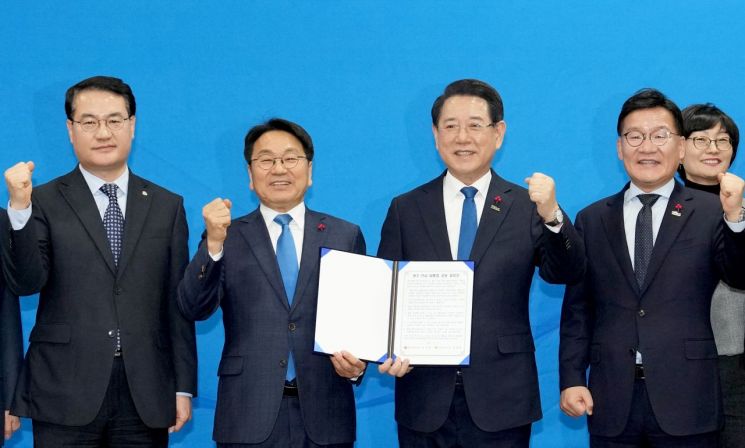 Kim Youngrok, Governor of Jeollanam-do Province (third from the left in the photo), expressed various opinions on the administrative integration of Gwangju and Jeonnam at the luncheon meeting hosted by President Lee Jae-myung at the Blue House on the 9th. Provided by Jeonnam Province
On January 9, Jeollanam-do announced that it had secured strong momentum for the launch of the "Republic of Korea's First Gwangju-Jeonnam Administrative Integration" in July, following confirmation of the central government's full support for the integration during a luncheon meeting hosted by President Lee Jaemyung at the Blue House.
The luncheon was attended by President Lee, Kim Youngrok, Governor of Jeollanam-do, Kang Gijeong, Mayor of Gwangju Metropolitan City, and local National Assembly members, who reaffirmed the need for integration and reached a consensus on concrete national-level support measures.
President Lee stated, "I am grateful for the decisions made by the two local leaders to pursue integration, which is not an easy task, from a broad and forward-looking perspective," and promised, "We will provide extensive support across finance, industry, and administration so that Gwangju and Jeonnam, which have contributed to the development of Korean democracy, can usher in a new era."
In particular, President Lee highlighted groundbreaking economic support measures, such as attracting renewable energy-based industries in line with the "energy transition" and considering the establishment of a semiconductor belt in the southern region, emphasizing that administrative integration will serve as a powerful driver for government support.
A concrete agreement was also reached regarding the method of integration.
During the meeting, Governor Kim Youngrok proposed maintaining the existing 27 cities, counties, and districts, keeping the current system for local council and basic local government head elections, and utilizing both city and provincial government buildings. President Lee agreed with these proposals.
Accordingly, the current system will be maintained and the integration process will proceed without confusion such as redistricting.
Taking the timeline into consideration, a consensus was formed to proceed through resolutions by the city and provincial councils instead of a residents’ referendum. However, President Lee requested, "Please hold numerous local briefings to reflect the opinions of residents as much as possible."
Clear answers were also provided regarding the region's top concerns: the establishment of an integrated national medical school and the relocation of Muan Airport.
President Lee stated, "No region will suffer any disadvantage or loss as a result of the integration," making it clear that integration will be a catalyst, not an obstacle, for resolving pending issues.
After the luncheon, at a citizen briefing session on administrative integration held at the Kim Daejung Convention Center in Gwangju, Mayor Kang Gijeong and others shared the results of the Blue House discussions and explained to the citizens the progress made so far, major agreements between the two regions, and future directions for the integration process.
Following the meeting, Governor Kim expressed, "Today is truly an inspiring day," and added, "Integration means economic growth, jobs, and balanced development. 1+1 will become more than 3, opening a new era of prosperity for the 27 cities, counties, and districts of Gwangju and Jeonnam."
Meanwhile, Jeollanam-do plans to accelerate the launch of the Republic of Korea's first integrated metropolitan local government in July by uniting the aspirations of 3.2 million residents, based on the government's promises and the support of the local political community.
© The Asia Business Daily(www.asiae.co.kr). All rights reserved.
!["The Woman Who Threw Herself into the Water Clutching a Stolen Dior Bag"...A Grotesque Success Story That Shakes the Korean Psyche [Slate]](https://cwcontent.asiae.co.kr/asiaresize/183/2026021902243444107_1771435474.jpg)
















