S-1 Corporation Releases "2026 Security Trends" Report
There are predictions that this year, the security industry paradigm will shift from "detection" to "prediction." With the adoption of artificial intelligence (AI), there is a clear demand for AI-based pre-detection and prediction systems, moving beyond the traditional approach of post-incident confirmation.
On January 11, S-1 Corporation announced its "2026 Security Trends" report, which included these findings. The company conducted a survey of 27,207 of its customers from January 2 to January 6 and performed a comprehensive analysis of crime and accident statistics.
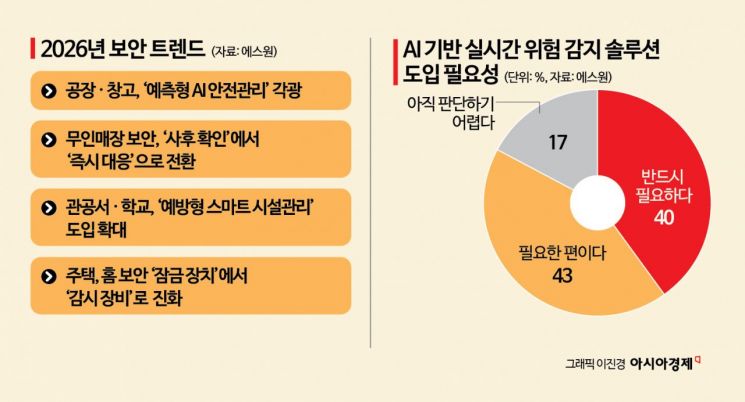
S-1 Corporation outlined detailed trends for each type of space, including industrial sites, unmanned stores, public institutions and schools, and residential areas. In industrial sites, "predictive AI safety management" is expected to gain attention. According to the survey, the most threatening factors in industrial sites were time gaps when no personnel are present (41%), dependence on human labor (28%), and post-incident awareness (27%). When asked about security systems they would like to improve, the majority of respondents cited "pre-incident risk detection" (49%) and "real-time monitoring" (36%). Reflecting this demand, 83% of respondents said that the adoption of "AI-based real-time risk detection solutions" is necessary-a 25 percentage point increase compared to last year’s response (58%) to the same question.
In unmanned stores, the greatest operational challenges were "post-incident awareness" (46%), "burden of constant monitoring" (38%), and "difficulty in real-time response" (15%). This indicates a significant burden due to the need to identify situations only after an incident occurs or for store owners to continuously monitor operations. The most desired security system was "AI-based automatic detection of abnormal behavior" (46%), followed by "dispatch of professional personnel for response" (24%), and "automatic storage of video evidence" (17%).
For public institutions and schools, the introduction of "preventive smart facility management" is expected to expand. In this survey, the most concerning issues in facility safety management were "delayed response to fires or disasters" (28%), "unauthorized entry by outsiders" (27%), "accidents involving students or visitors" (16%), and "aging or malfunctioning facilities" (15%). The most desired facility management systems were "real-time monitoring of facility status" (45%) and "pre-detection of abnormal signs" (26%). There is a growing recognition that management methods should shift from post-incident response to preemptive prevention. Regarding smart facility management solutions, 93% of respondents agreed on the need for adoption.
In residential areas, as home intrusions and package thefts increase, security systems are evolving into surveillance equipment. The survey found that the current problems with security systems are "inability to check while away from home" (41%), "post-incident awareness" (28%), and "difficulty in assessing the situation outside the front door" (23%). When asked about necessary security systems, most respondents cited "front door CCTV" (53%), "dispatch security service" (21%), and "indoor CCTV" (15%). This indicates that the focus of home security is shifting toward monitoring and responding to situations using surveillance equipment such as CCTV. Additionally, 34% of respondents said they intend to install front door CCTV.
A representative from S-1 Corporation stated, "Home security is evolving from a lock-based system focused on preventing intrusions to a surveillance system that checks the situation at the front door and collects evidence," adding, "Active home security solutions that can simultaneously prevent and respond to package theft and intrusion crimes will become essential household items."
© The Asia Business Daily(www.asiae.co.kr). All rights reserved.

















