Im Gapsoo Appointed as Government Representative for Negotiations with the United States
On January 9, the government officially launched the "Korea-U.S. Interagency Nuclear Cooperation Consultative Body." This task force (TF) will be responsible for negotiations with the United States to expand Korea’s authority over uranium enrichment and spent nuclear fuel reprocessing, as discussed at the Korea-U.S. summit in November last year.
 On the morning of the 9th, participants of the intergovernmental task force for securing peaceful and commercial nuclear fuel enrichment and reprocessing capabilities are taking a commemorative photo at the Ministry of Foreign Affairs annex of the Government Seoul Building. Photo by Ministry of Foreign Affairs
According to the Ministry of Foreign Affairs, the first meeting of the intergovernmental TF for securing peaceful and commercial enrichment and reprocessing capabilities was held at 10 a.m. that day at the Seoul Government Complex. Ambassador Im Gapsoo, who previously served as a nonproliferation expert at the International Atomic Energy Agency (IAEA), was appointed as the government representative. The TF includes relevant agencies such as the Ministry of Foreign Affairs, Ministry of Science and ICT, Ministry of Climate, Energy and Environment, Ministry of Trade, Industry and Energy, Nuclear Safety and Security Commission, Korea Atomic Energy Research Institute, Korea Hydro & Nuclear Power, and the Korea Institute of Nuclear Nonproliferation and Control.
The Ministry of Foreign Affairs reported that, at the first meeting, participants reviewed the roles and cooperation frameworks of each ministry regarding key issues and tasks related to enrichment and reprocessing, and exchanged views on the direction and plans for negotiations with the United States.
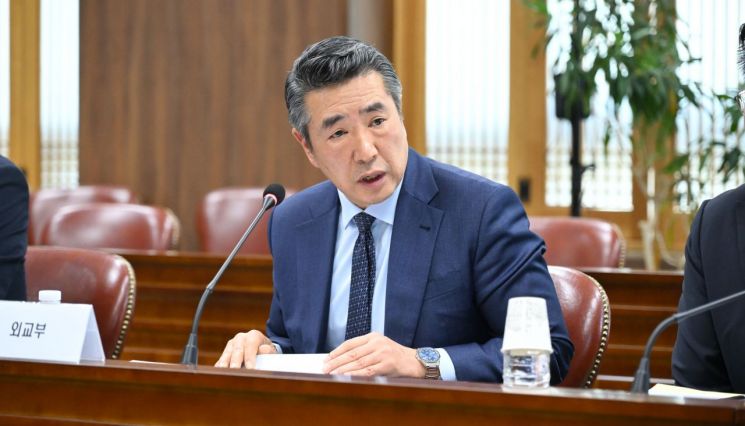 On the morning of the 9th, at the Ministry of Foreign Affairs annex of the Government Seoul Office Building, Im Gapsoo, the government representative, is speaking at the first meeting of the intergovernmental task force for securing peaceful and commercial nuclear fuel cycle capabilities. Ministry of Foreign Affairs
Korea’s enrichment and reprocessing technology has been restricted by the United States for more than 50 years since the first Korea-U.S. nuclear cooperation agreement was signed in 1974. If Korea gains autonomous authority over enrichment and reprocessing in accordance with the agreement between the two leaders, it will have historical significance in terms of securing so-called "nuclear sovereignty."
However, the process of persuading and negotiating with hardline nonproliferation advocates, including those in the U.S. Department of Energy, is expected to be far from easy. The government plans to accelerate efforts by emphasizing that, as a nuclear power plant exporter, Korea has sufficient justification to secure a complete nuclear fuel cycle from fuel fabrication to reprocessing, and that this is a matter agreed upon by the two countries’ leaders.
The Ministry of Foreign Affairs stated, "Going forward, we will regularly hold director-general-level TF meetings and working-level consultations to review major issues related to enrichment and reprocessing in stages, and will pursue a whole-of-government response to create domestic and international conditions for securing peaceful and commercial enrichment and reprocessing capabilities."
Meanwhile, the Ministry of Foreign Affairs also formed its own TF of three working-level staff on January 5, separate from the intergovernmental TF, to support the work of the government representative for Korea-U.S. nuclear cooperation.
© The Asia Business Daily(www.asiae.co.kr). All rights reserved.


















