Dozens of Resale Posts Uploaded Daily
Up to 30 Million Won Fine for Violations
Recently, taking advantage of the craze for "Dubai Chewy Cookies (Dujjonku)," illegal activities such as reselling cookies on secondhand trading platforms or selling homemade products without business registration have been rampant. Experts point out that not only should individual consumers exercise caution, but platform-level filtering systems also need to be strengthened.
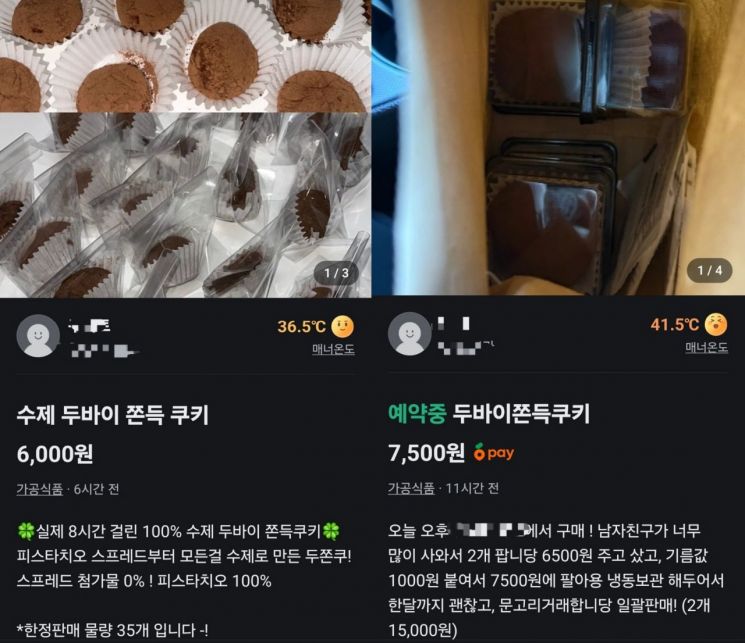 On the 12th, a post related to the trading of chewy cookies from Dubai was uploaded on the secondhand trading platform Danggeun Market.
As of January 13, dozens of posts reselling Dubai Chewy Cookies are being uploaded daily on secondhand trading platforms. Prices range from 4,000 won per cookie to over 10,000 won with added premiums. Sellers are seeking buyers by saying, "I bought them after waiting in line, but I have too many, so I'm letting some go," or "They didn't suit my taste, so I'm selling the remaining ones at the original price."
Some sellers add a so-called "service fee" to the purchase price when reselling. One seller posted, "I bought them for 6,500 won each, but I'm selling them for 7,500 won to cover gas expenses." There have also been cases where dozens of homemade cookies were sold in bulk without any business registration.
The problem is that many of these transactions violate current laws. According to the Food Sanitation Act, foods produced by instant sales and manufacturing businesses, such as cafes, must be delivered directly to the final consumer at the store, and it is prohibited for third parties to distribute or resell these products. Arbitrarily opening pre-packaged finished products and dividing them for individual sale-known as "repackaging sales"-is also considered unregistered business activity and is subject to penalties.
There is also a high risk of violating the Food Labeling and Advertising Act. All food products must display the product name, expiration date, and list of ingredients on the minimum sales unit packaging. Even if the expiration date is written in a secondhand trading post, if the information is not attached to the product packaging itself, it constitutes "distribution of unlabeled food." Violations can result in imprisonment for up to three years or a fine of up to 30 million won.
However, enforcement is not easy. An official from Songpa District Office explained, "Selling homemade food without business registration on the platform is clearly illegal, but if someone resells a purchased product as a one-time transaction, it could be considered a simple personal transaction, making it difficult to determine whether it constitutes business activity."
Lee Youngae, a professor of consumer studies at Incheon National University, emphasized, "Many consumers misunderstand transactions on the platform as a form of information sharing and fail to recognize their illegality. While individual caution is important, platforms should strengthen monitoring and establish systems to proactively block posts related to illegal food transactions."
© The Asia Business Daily(www.asiae.co.kr). All rights reserved.

















