Four New Business Categories: Sales, Import, Production, and Entrusted Management
Facility Standards and Mandatory Legal Training Required
Guidance Period in Effect Until December 13, 2026
Goyang Special City in Gyeonggi Province (Mayor Lee Donghwan) announced on January 9 that it is officially implementing the 'Wildlife Business Permit System' to prevent the indiscriminate distribution of wildlife and to establish a systematic management framework.
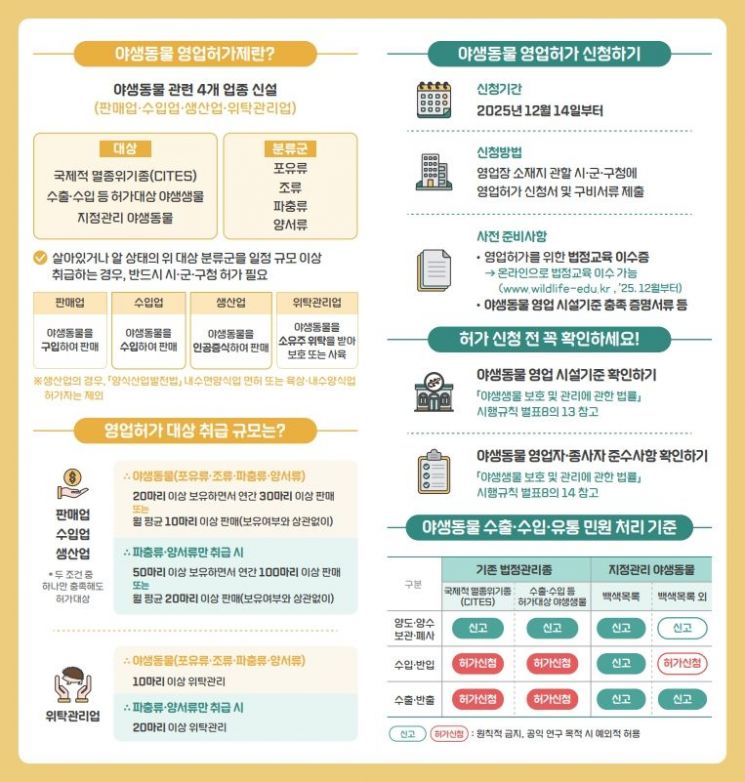
The 'Wildlife Business Permit System' was enacted following the revision of the 'Act on the Conservation and Management of Wildlife' on December 13, 2022, and after a three-year grace period, it has been in effect since December 14, 2025. As a result, any business handling live or egg-stage wildlife above a certain scale must obtain a permit from the relevant local government.
The newly established permit requirement applies to four types of businesses: ▲Sales (purchasing and selling wildlife), ▲Import (importing and selling wildlife), ▲Production (artificially breeding and selling wildlife), and ▲Entrusted Management (protecting or raising wildlife entrusted by owners).
The animals subject to regulation include internationally endangered species (CITES), wildlife requiring export or import permits, and the newly designated 'managed wildlife.' The targeted taxonomic groups are mammals, birds, reptiles, and amphibians.
The permit criteria vary depending on the species handled and the scale of the business. For 'sales, import, and production' businesses, a permit is required if the business possesses 20 or more mammals (or similar species) and sells 30 or more annually, or sells 10 or more per month on average regardless of inventory. For businesses handling only reptiles or amphibians, a permit is required if they possess 50 or more and sell 100 or more annually, or sell 20 or more per month on average regardless of inventory.
For 'entrusted management' businesses, a permit is required if they manage 10 or more mammals (or similar species), or 20 or more if handling only reptiles or amphibians.
In particular, the obligation to report 'transfer and acquisition' of wildlife during transactions applies equally to all parties, regardless of whether they have a business permit or the scale of sales. Therefore, even small-scale sellers who are not required to obtain a permit must take special care not to violate the reporting obligation.
To obtain a business permit, applicants must complete legally mandated training in advance and have breeding facilities appropriate for the ecological characteristics of the animals. However, due to building use regulations, business permits cannot be issued for shared residential buildings such as apartments, so this must be checked in advance.
To ensure the stable implementation of the new system, the city will operate a one-year guidance period until December 13, 2026. However, this period is intended to provide guidance and support for legal compliance, and does not guarantee exemption from penalties. In cases of intentional violations or failure to comply with corrective orders, administrative action may be taken even during the guidance period.
Detailed information about the system can be found in the notices section of the 'Wildlife Integrated Management System' operated by the Ministry of Climate, Energy and Environment. Permit applications should be submitted in writing to the Environmental Policy Division of Goyang Special City, along with the application form and required documents.
An official from Goyang Special City stated, "The core of this system is to prevent indiscriminate wildlife trading and to establish a systematic management structure. Existing business operators must apply for a permit before the one-year guidance period ends, and the city will do its utmost to provide publicity and guidance to prevent confusion in the field."
© The Asia Business Daily(www.asiae.co.kr). All rights reserved.

















