Gwangsan District in Gwangju Operates Labor and Human Rights Counseling Center
Addressing Gaps in Protection Through Wage Claims, Industrial Accident Support, and Emergency Assistance
"I didn't receive my final month's salary before leaving my job. Is there any way to resolve this?"
Mr. A, a migrant worker from Uzbekistan, faced difficulties with unpaid wages after resigning from a transportation and delivery company in another region. While searching for a place to seek help and express his frustration, he learned about the labor and human rights counseling center for migrant workers operated by Gwangsan District in Gwangju. In September last year, Mr. A visited the center during the weekend, where, with the help of a labor attorney, he reviewed the terms of his employment contract and filed a wage claim with the labor office.
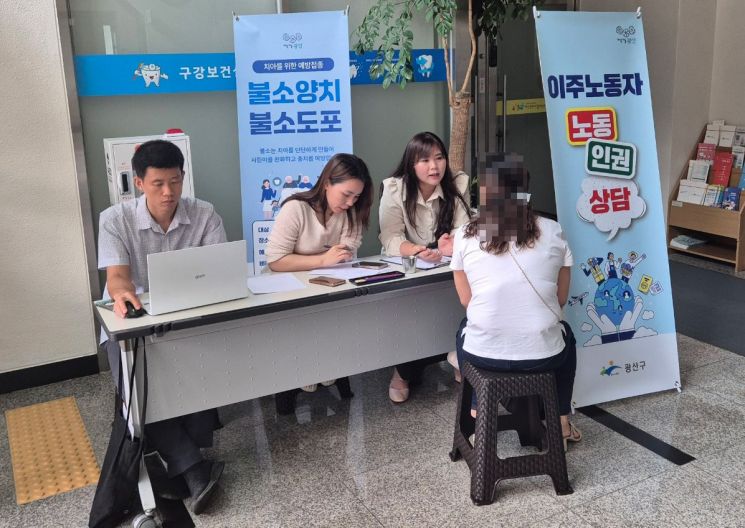 The Labor Rights Counseling Center operated by Gwangsan District last year during weekday nights and weekends to protect the human rights of migrant workers. Provided by Gwangsan District
Gwangsan District announced that the labor and human rights counseling center for migrant workers, operated as part of its initiative to protect migrant workers' rights, is helping to fill the gaps in the protection of migrant workers' interests. The center was established to provide free professional counseling on the inconveniences, discrimination, and human rights violations that migrant workers experience in their daily lives and workplaces.
Taking into account that it is difficult for migrant workers to make time during weekday daytime hours due to work conditions, Gwangsan District opened the counseling center on weekday evenings and weekends starting in September last year. The center is staffed with either a lawyer or a labor attorney, along with two interpreters for Russian, Vietnamese, Myanmar, and Cambodian languages.
Currently, about 26,000 migrants from 65 countries, including Vietnam, China, and Uzbekistan, live in Gwangsan District. This accounts for approximately 6.3% of the total population.
Since the center began operating, workers have come forward with concerns they had previously been unable to voice. Last year, the center was open 16 times, and there were 25 counseling sessions, including both in-person and telephone consultations. The cases ranged from unpaid severance pay to conflicts with employers over industrial accident claims after workplace injuries, such as a finger injury. Some migrant workers even traveled from other regions to Gwangsan District in search of help.
Gwangsan District provided guidance on rights that could not be exercised due to lack of information about the system or misunderstanding of legal regulations, and connected workers to protection procedures. For example, the district supported a Vietnamese youth in reporting unpaid severance pay after his time spent abroad due to his father's death was not recognized as part of his employment period. The center assisted injured migrant workers in filing industrial accident claims, and in cases where workers were assaulted by fellow migrants, it coordinated with the police to provide emergency support for medical and living expenses. For issues requiring legal review, the center offered additional counseling and follow-up support.
Gwangsan District plans to continue operating the counseling center this year to further promote the rights of migrant workers. An official from Gwangsan District stated, "The labor and human rights counseling center is becoming a channel for migrant workers to voice a range of concerns, from unpaid wages to residency issues, and to fill the gaps in the protection of their rights and interests," adding, "We will strengthen cooperation with relevant agencies and organizations to expand the safety net for migrants' rights."
© The Asia Business Daily(www.asiae.co.kr). All rights reserved.
![Clutching a Stolen Dior Bag, Saying "I Hate Being Poor but Real"... The Grotesque Con of a "Human Knockoff" [Slate]](https://cwcontent.asiae.co.kr/asiaresize/183/2026021902243444107_1771435474.jpg)
















