Lee Haemin Hosts Forum on Power Supply Solutions for AI Data Centers
As the power supply shortage for artificial intelligence (AI) data centers in the Seoul metropolitan area continues, there have been calls to attract data centers to non-metropolitan regions by reducing costs and relaxing power purchase regulations.
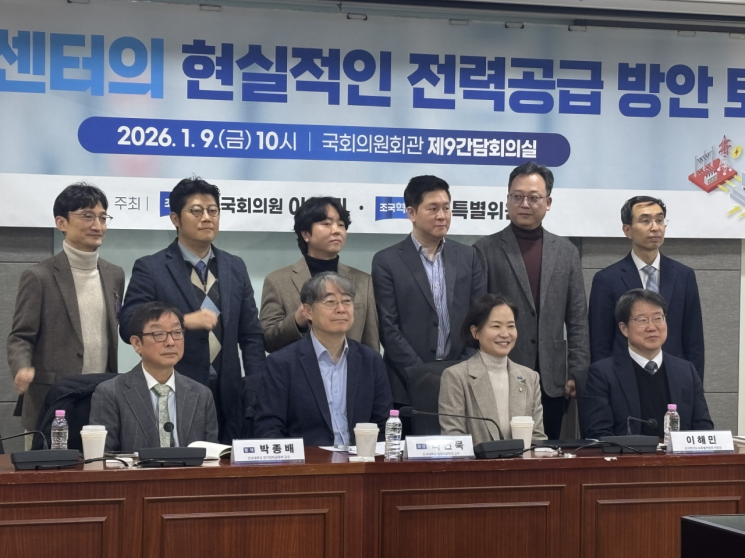 On the 9th, attendees are taking photos at the "Practical Power Supply Measures for AI Data Centers" forum hosted by the office of Lee Haemin, a member of the Progressive Innovation Party, at the National Assembly in Yeouido. Photo by Hwang Seoyul chestnut@
On January 9, the office of Lee Haemin, a member of the Progressive Innovation Party, held the "Practical Power Supply Measures for AI Data Centers" forum at the National Assembly in Yeouido, addressing the structural limitations of the domestic electricity market regarding AI data center power supply and exploring possible solutions.
Assemblyman Lee Haemin stated, "Attracting AI data centers is essential for balanced regional development and for Korea to advance as an AI G3 nation. However, the reality is far from easy. Currently, about 40% of the country's electricity consumption and more than 70% of data centers are concentrated in the Seoul metropolitan area, and both the transmission network and power planning are unable to keep up with the rapidly increasing demand from AI."
Professor Park Jongbae of Konkuk University's Department of Electrical and Electronic Engineering, who gave the keynote presentation, also pointed out, "The Seoul metropolitan area accounts for 40% of the nation's electricity demand, but the supply is severely insufficient. As a result, power is being supplied by constructing transmission networks from non-metropolitan regions." However, he also noted that building transmission lines from non-metropolitan areas to the Seoul metropolitan area faces significant challenges due to low local acceptance, difficulties in negotiations with local governments, adequacy of compensation, and complex permitting procedures.
Professor Park argued that there is a need for policies to incentivize the establishment of data centers in regions with excess power generation, such as Honam, Yeongnam, Gangwon, and Chungcheong. In the short term, he suggested: ▲ allowing direct power purchase agreements (PPAs) between non-metropolitan AI data centers and nearby power plants; ▲ drastically reducing transmission network usage fees; and ▲ prioritizing the implementation of differentiated electricity rates between non-metropolitan and metropolitan areas. For the mid- to long-term, he recommended strengthening the transmission network after 2030 and eventually permitting AI data centers in the metropolitan area.
Jo Daekeun, a senior advisor at Law Firm Gwangjang, referenced PPA cases from Amazon, Microsoft, and Google, and proposed the introduction of hybrid (renewable energy + carbon-free) PPAs. He stated, "Hybrid power should be secured through PPA transactions, but restrictions on the target, scale, and duration should be lifted to allow consumers to strategically secure electricity."
Meanwhile, Assemblyman Lee introduced a special bill the previous day to promote AI data centers. The bill aims to streamline the permitting process for AI data centers and grant special provisions allowing direct power trading for non-metropolitan AI data centers.
© The Asia Business Daily(www.asiae.co.kr). All rights reserved.

















