Death Penalty Sought 406 Days After Martial Law Declaration
"No Remorse, No Apology, No Grounds for Leniency"
On January 13, 2026, the special prosecutor team for insurrection, led by Cho Eunseok, requested the death penalty for former President Yoon Seok-yeol, who is facing charges of leading an insurrection related to the December 3, 2024 emergency martial law incident. With this, 406 days after the declaration of emergency martial law and 345 days after he became the first sitting president to be indicted and detained, the main trial on the charge of leading an insurrection has concluded, leaving only the sentencing ahead.
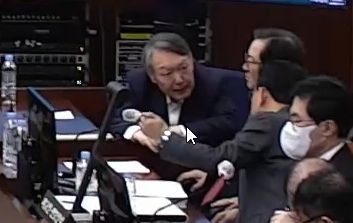 Former President Yoon Seok-yeol, who was indicted on charges of leading a rebellion related to the December 3 emergency martial law, attended the final trial on the charge of leading a rebellion held at Criminal Courtroom 417 of the Seoul Central District Court in Seocho-gu, Seoul on the 13th, where he was seen conversing with his lawyers.
 The trial on that day is scheduled to proceed in the order of examination of documentary evidence by Yoon’s defense team, final opinions and sentencing requests by the special prosecution team, final arguments by the defense, and last statements by the eight defendants.
Provided by Seoul Central District Court. Yonhap News.
During the final hearing for Yoon Seok-yeol’s insurrection leadership case, which began at 9:20 a.m. under the Criminal Agreement Division 25 of the Seoul Central District Court (Presiding Judge Ji Guyoun), the special prosecutor team made this sentencing request.
The special prosecutor team stated, “The emergency martial law was a grave constitutional destruction incident caused by anti-state forces, and it was an intelligent, premeditated, and organized crime that abused the president’s status and authority. Not only has the defendant shown no remorse, but he has also never once apologized to the people. There are no circumstances that would warrant special consideration in favor of the defendant,” explaining the reasons for their sentencing request.
They continued, “Although this insurrection was overcome thanks to public resistance and swift action by the National Assembly, it reveals that there remains a significant risk of repeated attempts to disrupt the constitutional order through a ‘palace coup,’ despite the fact that the Chun Doo-hwan and Roh Tae-woo factions were previously held accountable for their insurrections. By holding the public officials who destroyed the constitutional order to an even stricter standard than those previous factions, South Korea must demonstrate that it can defend its constitutional order through its criminal justice system.”
Former President Yoon appeared in court in person, with short hair and wearing a navy suit. During the afternoon session, he was seen dozing off with his eyes closed.
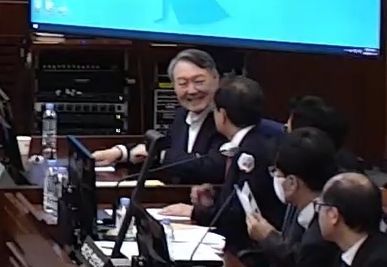 Former President Yoon Seok-yeol, who was indicted on charges of leading the December 3 emergency martial law-related rebellion, is seen smiling while talking with his lawyers during the final trial on the charge of leading the rebellion held on the 13th at Criminal Courtroom 417 of the Seoul Central District Court in Seocho-gu, Seoul. Photo by Yonhap News Agency.
Former President Yoon was indicted and detained in January last year on charges of inciting a riot for the purpose of undermining the constitutional order, including the declaration of emergency martial law on December 3, 2024. He is also accused of attempting to arrest and detain key figures such as President Lee Jaemyung (then leader of the Democratic Party of Korea) and former People Power Party leader Han Donghoon, as well as blocking the National Assembly to prevent a resolution to lift emergency martial law.
The special prosecutor team determined that both the purpose and the specific execution of the emergency martial law satisfied all the requirements for insurrection. They also classified the acts of deploying military forces after the declaration, ordering the blockade of the National Assembly to obstruct the resolution to lift martial law, and attempting to arrest politicians as crimes disrupting the constitutional order.
In contrast, former President Yoon’s defense argued, “The emergency martial law was merely a measure to alert the public to a crisis caused by a series of impeachments of key government officials and budget cuts by the opposition party, and there was no intention to disrupt the constitutional order.” They have denied all charges and called for the case to be dismissed. The trial on the charge of leading an insurrection began with its first formal hearing on April 14 last year and has been held 42 times up to this day. A total of 61 witnesses, including Hong Jangwon, former First Deputy Director of the National Intelligence Service, and Yeo Inhyeong, former Counterintelligence Commander, have testified in court. After being re-detained by the special prosecutor team in July last year, former President Yoon refused to attend court for about four months, maintaining a “stand-off” strategy. However, since October 30 last year, when key witnesses such as former Special Warfare Commander Kwak Jonggeun began to testify, he has resumed attending the hearings.
On this day, the final trial was also held for seven high-ranking military and police officials, including former Minister of National Defense Kim Yonghyeon and former National Police Agency Commissioner Cho Jiho, who are accused of participating in important insurrection-related missions. The final trial included the special prosecutor team’s sentencing requests, the defense’s closing arguments, and the defendants’ final statements, after which the trial concluded. The verdict for the first trial is expected no later than mid-February. Even in insurrection cases, if there are circumstances that warrant consideration, the judge may partially reduce the sentence. The death penalty may be commuted to life imprisonment or 20 to 50 years in prison; life imprisonment or life detention may be reduced to 10 to 50 years in prison or detention.
© The Asia Business Daily(www.asiae.co.kr). All rights reserved.


















