Shift in Distribution of Students with Migrant Backgrounds, Previously Concentrated in Elementary Schools
Surge in "Children from Foreign Families" Outpaces "Korea-Born" Students
Middle and High School Students: 27.8% to 41.9%... Up by 14.1 Percentage Points
Need for an Education Support System Tailored to Changing Trends
The number of students with migrant backgrounds in South Korea has surpassed 200,000 for the first time, with middle and high school students now accounting for over 40% of the total. This shift is attributed to the children of early international marriages advancing to higher grades, as well as an increase in children from foreign families and mid-immigrant students. As a result, the proportion of students with migrant backgrounds, which was previously concentrated among elementary school students, is now changing across different grade levels.
According to the Ministry of Education on January 9, the proportion of middle and high school students among all students with migrant backgrounds increased from 27.8% in 2012, when the relevant statistics were first compiled, to 41.9% in 2025, marking a 14.1 percentage point rise. This means that four out of every ten students with migrant backgrounds are now middle or high school students.
This trend is driven by a decrease in the proportion of children born in Korea to international marriage families (where one parent is a foreign national), and a significant increase in the proportion of children from foreign families (where both parents are foreign nationals). The number of "mid-immigrant" children-those born abroad to international marriage families-has also risen sharply. Many of these students enter middle or high school directly without passing through kindergarten or elementary school in Korea, which is impacting the previously elementary school-centered distribution of students with migrant backgrounds.
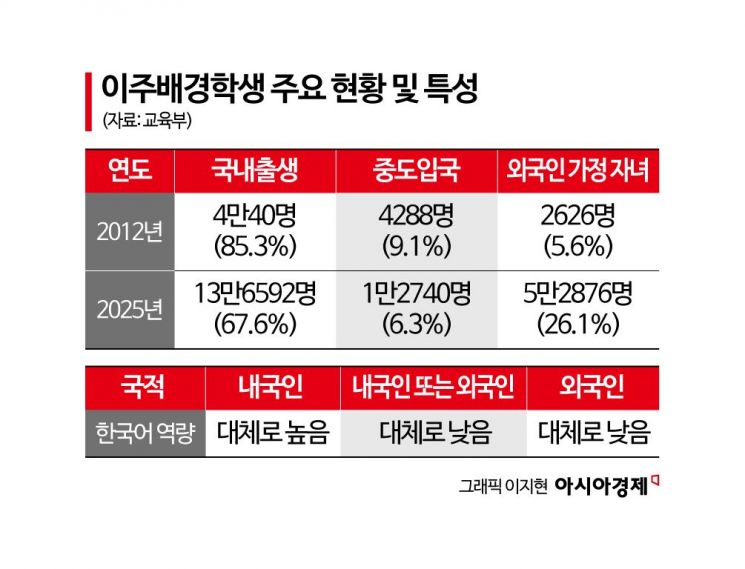
Specifically, the proportion of children born in Korea to international marriage families dropped from 85.3% in 2012 to 67.6% in 2025, while the proportion of children from foreign families surged from 5.6% to 26.1%. This indicates a growing number of students who must begin their education in Korea directly at the middle or high school level, without prior experience in Korean kindergarten or elementary schools. This trend is evident in the distribution of students with migrant backgrounds across grade levels over the past five years.
In 2021, the proportion of students with migrant backgrounds in elementary schools was 69.6%, but this is projected to decrease to 57.7% in 2025, an 11.9 percentage point drop. During the same period, the proportion in middle schools increased from 21.2% to 25.3%, a 4.1 percentage point rise, while in high schools it nearly doubled from 8.9% to 16.6%.
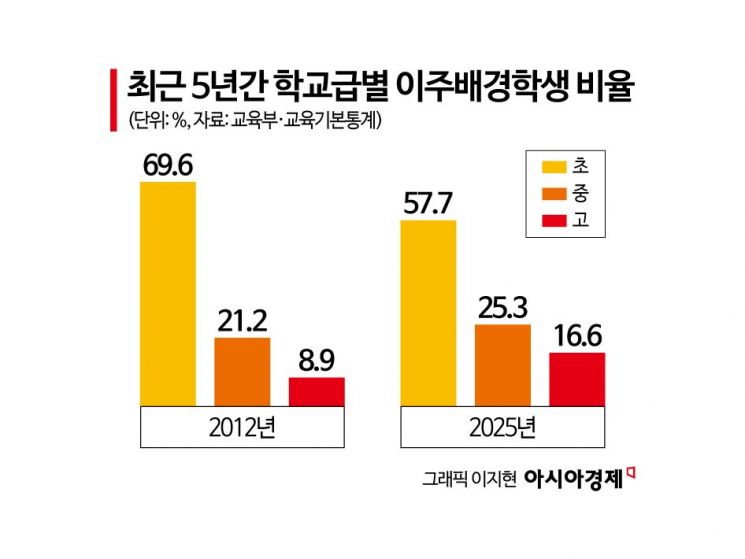
Not only has the proportion increased, but the absolute number has also grown. As of April last year, there were 202,208 students with migrant backgrounds, a 26.3% increase from 160,058 in 2021. By grade level, the number in elementary schools remained similar at around 110,000 (111,371 to 116,601), but the number in middle schools jumped 50.7% from 33,950 to 51,172, and in high schools, it soared by 135.0% from 14,308 to 33,622 during the same period.
Students with migrant backgrounds who were born in Korea are generally exposed to the Korean language from an early age and therefore have little difficulty communicating. However, those who immigrated mid-way or whose parents are both foreign nationals and must adapt to Korean life directly in middle or high school typically have lower Korean language proficiency. There are growing calls for an education support system tailored to the current situation, where the number of students with migrant backgrounds who do not speak Korean is rapidly increasing.
This year, the Ministry of Education plans to develop Korean language proficiency diagnostic tools tailored to the developmental stages of students with migrant backgrounds and to provide learning support based on diagnostic information. A Ministry of Education official stated, "We will implement customized education at each stage by expanding Korean language classes and commissioned programs, and will distribute field-oriented materials, such as the newly developed 'Learning Korean,' which is a Korean language education resource focused on subject vocabulary learning."
© The Asia Business Daily(www.asiae.co.kr). All rights reserved.
![User Who Sold Erroneously Deposited Bitcoins to Repay Debt and Fund Entertainment... What Did the Supreme Court Decide in 2021? [Legal Issue Check]](https://cwcontent.asiae.co.kr/asiaresize/183/2026020910431234020_1770601391.png)