Basic Plan for Undergrounding Projects Through 2040 Under Review
Citywide Undergrounding Rate at 62%... Complex Administrative and Financial Issues
New Plan to Reflect Urban Planning Amendments and Additional Factors
New Technologies and Co
Seoul City is accelerating its efforts to eliminate utility poles. Undergrounding utility poles has been consistently demanded, as they cause inconvenience not only to pedestrians and vehicles but also pose problems during firefighting operations. In response to the slow pace of progress, the city plans to implement various measures to boost the project starting this year, including the adoption of new construction methods and the utilization of public contributions.
According to the maintenance industry on January 9, the city is currently establishing the basic plan for the undergrounding project of overhead distribution lines until 2040. The "basic plan for the undergrounding project" is renewed every five years, and the guideline to be newly applied from 2026 is currently in its final review stage.
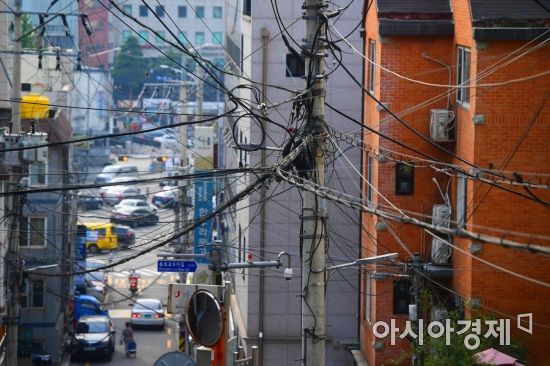 Seoul City is currently establishing the basic plan for the undergrounding project of overhead distribution lines until 2040. The guideline, which will be newly applied from 2026, is currently in the final review stage. The photo shows a densely populated residential area in Yaksu-dong, Seoul. Photo by Moon Honam
As of January 2026, the overall undergrounding rate in Seoul remains at around 62%, similar to the previous year. The process does not simply involve removing utility poles; it also requires burying existing infrastructure underground, which incurs significant costs at every stage, including excavation, conduit installation, and restoration. During this process, issues regarding cost-sharing among local governments, power companies, and telecommunications providers frequently arise.
The new basic plan for the undergrounding project will involve reselecting the optimal routes for each district, taking into account on-site construction conditions (such as the number of lanes and sidewalk width) and specific characteristics that require pedestrian environment improvements, including tourist and densely populated areas, car-free streets, and protected zones for people with limited mobility. Additionally, the city is considering ways to revitalize the project by utilizing public contribution incentives or revising related standards, such as the "Operational Guidelines for Underground Relocation of Overhead Distribution Lines."
At a recent expert advisory review, new technologies and construction methods aimed at speeding up the project were introduced. Notable examples include mini-trenching, which allows for construction with minimal excavation compared to traditional wide-area road excavation; horizontal directional drilling (HDD), a method that enables horizontal underground excavation; and underground compact distribution stations, which consolidate devices that were previously installed individually into a single underground distribution station. However, there are concerns that these new technologies and methods may present additional challenges in securing budgets, as they increase the financial burden on local governments.
Fortunately, government-level support measures are also underway. For instance, at the end of last month, the Ministry of Science and ICT held the "Aerial Cable Maintenance Council" and decided to increase the budget for undergrounding projects to approximately 3 trillion won over the next five years. In line with the "Dig-Once" principle, a management plan is also being developed to prevent redundant excavation by burying all facilities in a single excavation. The government plans to establish joint planning and prior consultation procedures among underground facility management agencies and, through the formation of a council, create a long-term management plan for underground infrastructure.
An official from one of Seoul's districts stated, "There are cases where the project is delayed due to citizen complaints and disruption to traffic flow caused by construction, but it is an essential project for ensuring public safety in the event of fire or emergency situations. Various forms of support are needed to accelerate undergrounding through agreements with relevant agencies."
© The Asia Business Daily(www.asiae.co.kr). All rights reserved.
















