DNA Collected from Early Chalk Drawing and Compared with Relatives
Research Team: "Significant Aid in Authenticating the Artwork"
With the discovery of DNA (deoxyribonucleic acid) presumed to belong to Leonardo da Vinci in one of his works, there is growing interest in whether the abilities of da Vinci-widely regarded as one of the greatest geniuses in human history-can be genetically proven. On January 8, Yonhap News, citing the British daily The Telegraph and others, reported that the research team of the Leonardo da Vinci DNA Project (LDVP) detected DNA believed to be da Vinci's in his early chalk drawing, "Holy Child."
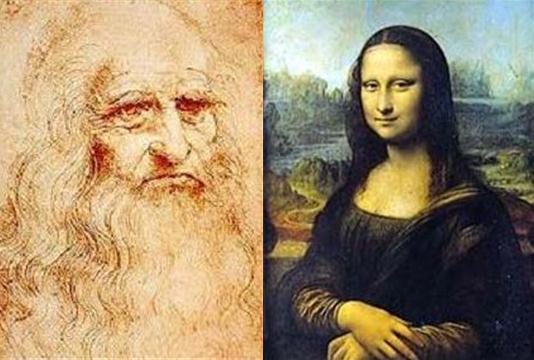 Leonardo da Vinci (left) and Mona Lisa. Photo by The Asia Business Daily Database
The LDVP is an international joint research team composed of anthropologists, microbiologists, and geneticists from universities and research institutes in France, Italy, Spain, Canada, and the United States. Their goal is to trace da Vinci's biological traces and reconstruct his DNA. The researchers carefully rubbed the edges of the artwork with a dry swab to collect minute biological material, and confirmed that the DNA fragments obtained in this process belonged to the same lineage as DNA found in a letter left by one of da Vinci's distant relatives. This is considered strong evidence that the DNA could indeed be da Vinci's. However, the LDVP noted that "DNA of this lineage is relatively common in the Italian region," and cautiously added that it could also belong to someone else who handled the artwork.
The analysis detected not only human DNA but also DNA from microorganisms, fungi, and plants. The research team explained that these biological traces could serve as important clues in reconstructing the environment and living sphere of da Vinci at the time the artwork was created. Experts believe that since da Vinci was known to use his fingers as well as brushes when painting, there is a high possibility that additional skin cells of his may be found on the paint or canvas surfaces. The LDVP plans to secure more DNA from other da Vinci works or artifacts related to his family to verify these results.
The researchers expect that if da Vinci's DNA can be clearly identified, it will be possible to scientifically analyze how his extraordinary visual abilities and creativity may be linked to genetic traits. There have been suggestions that da Vinci may have perceived the world at about 100 frames per second, which far exceeds the typical human visual processing capability of 30 to 60 frames per second. Furthermore, if a da Vinci DNA database is established, it could provide a groundbreaking turning point in authenticating da Vinci's works-one of the greatest unresolved issues in art history.
© The Asia Business Daily(www.asiae.co.kr). All rights reserved.
















