The cell of origin for intractable brain tumors has been identified. The cell of origin refers to the normal cell where the development of a malignant tumor first begins. By answering the question, "Where do tumors originate?", expectations are rising for a paradigm shift in early diagnosis and recurrence suppression treatment of brain tumors.
On January 9, KAIST announced that a joint research team led by Professor Joungho Lee of the Graduate School of Medical Science and Engineering at KAIST and Professor Seokgu Kang of the Department of Neurosurgery at Yonsei University Severance Hospital has, for the first time in the world, identified that 'IDH-mutant glioma' originates from glial progenitor cells (GPC) present in normal brain tissue.
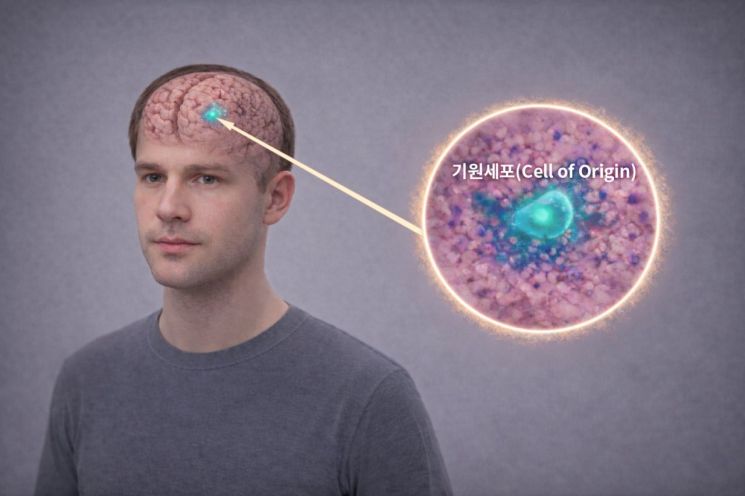 The origin cells of intractable brain tumors in the brain have been identified, raising expectations for a paradigm shift in early diagnosis and recurrence suppression treatment of brain tumors. Provided by KAIST (AI-generated image)
IDH-mutant glioma is a type of intractable brain tumor that primarily occurs in adults under the age of 50. It is initially diagnosed as a low-grade tumor and treated with surgery, radiation therapy, and chemotherapy, but in many cases, it progresses to a high-grade (malignant) tumor over several years or even decades.
In particular, IDH-mutant glioma has shown clearly different clinical features from glioblastoma (GBM), whose origin had previously been identified, suggesting that the mechanisms of development are different. However, there had been no direct evidence as to what develops into a tumor and where, within normal tissue.
In this regard, the joint research team conducted a detailed analysis of tumor tissue and the surrounding normal cerebral cortex obtained during extensive resection surgery. Through this, they discovered that even within brain tissue that appears normal, 'cells of origin' with IDH mutations already exist.
This is the first time it has been demonstrated that malignant brain tumors do not suddenly appear at a specific point in time, but rather grow slowly over a long period within normal brain tissue.
Another key achievement of this study is the use of cutting-edge research methods, such as single-cell spatial transcriptomics, to identify glial progenitor cells as the cells of origin.
Furthermore, the team successfully introduced the same genetic mutations found in patients into the glial progenitor cells of mice (animal models) and reproduced the actual process of brain tumor development. According to the research team, the tumors formed in the animal models were found to be highly similar to patient brain tumor tissue in both histological and transcriptomic characteristics.
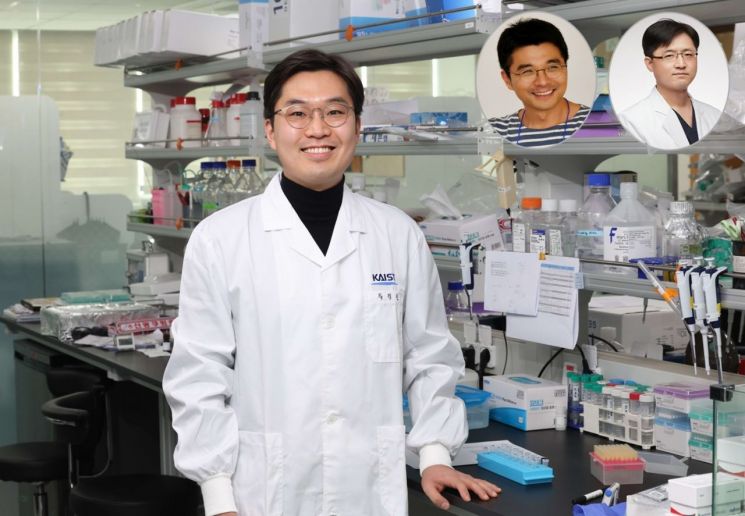 (From left) Jungwon Park, PhD, KAIST; (top) Joungho Lee, Professor, KAIST; Seokgu Kang, Professor, Yonsei University Severance Hospital. Courtesy of KAIST
This study is also regarded as an advancement of previous research that identified the 'origin' of brain tumors. In 2018, the joint research team revealed that the representative malignant brain tumor, glioblastoma, originates not from the tumor mass itself but from neural stem cells in the subventricular zone of the brain, marking a turning point in brain tumor research.
Subsequent research clarified that 'glioblastoma' and 'IDH-mutant glioma,' although both brain cancers, have entirely different starting cells and locations, making it clear that the development processes fundamentally differ depending on the type of brain tumor.
Professor Seokgu Kang (co-corresponding author) stated, "Brain tumors may not start exactly where the tumor mass is visible. Depending on the subtype of brain tumor, directly targeting the cell of origin and its location could provide an important clue for changing the paradigm of early diagnosis and recurrence suppression treatment."
Jungwon Park, PhD, postdoctoral researcher at the KAIST Graduate School of Medical Science and Engineering (first author), said, "This study is significant in that it identified the presence of cells of origin already existing in the brain tissue surrounding the tumor, and established a strategic basis for targeting these cells early to prevent tumor recurrence and improve patient survival rates."
Meanwhile, the results of this study (paper) were published in the international journal 'Science' on January 9.
© The Asia Business Daily(www.asiae.co.kr). All rights reserved.


















