Roadmap for Gwangju-Jeonnam Administrative Integration Shared at Provincial Council
Explanation of Launching Promotion Organization, Special Bill Proposal, and Special Provisions
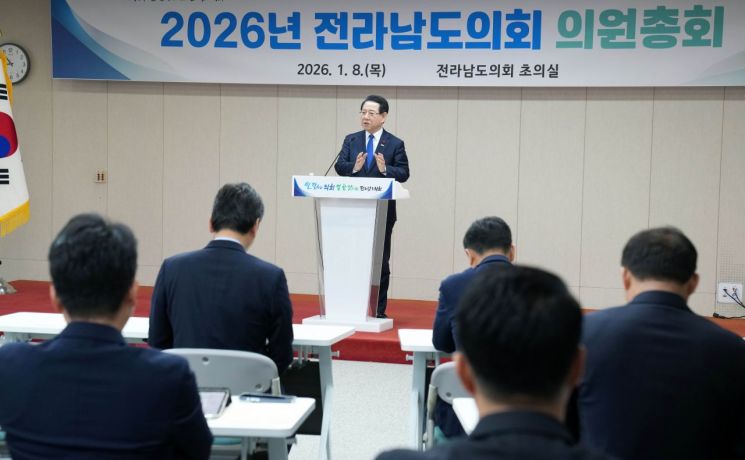 Kim Youngrok, Governor of Jeollanam-do, is attending a general meeting of the Jeollanam-do Provincial Council held at Choi's Room in the Jeonnam Provincial Council on the 8th, explaining the administrative integration of Gwangju and Jeonnam. Provided by Jeonnam Province
Kim Youngrok, Governor of Jeollanam-do, reiterated the need to accelerate the enactment of a special law for the administrative integration of Gwangju and Jeonnam.
On January 8, Jeollanam-do held a briefing session on the administrative integration of Gwangju and Jeonnam at a general meeting of the provincial council held at Choi's Room, sharing the roadmap for the necessity of integration, the launch of a promotion organization, and the proposal of a special bill.
Approximately 100 attendees participated in the session, including Governor Kim, Kim Taegyun, Chairman of the Jeonnam Provincial Council, council members, Kang Wiwon, Vice Governor for Economic Affairs and head of the Gwangju-Jeonnam Administrative Integration Promotion Planning Group, as well as department heads.
During the briefing, Governor Kim personally explained the need for promoting the administrative integration of Gwangju and Jeonnam, the implementation plan, and key issues regarding the integration.
Governor Kim explained that, "With the resolution of the issue regarding the relocation and integration of Gwangju Civil Airport and the military airport to Muan International Airport, a path for mutual cooperation between Gwangju and Jeonnam has opened. After much deliberation, I decided that it is appropriate to pursue the grand integration of Gwangju and Jeonnam as an AI and energy capital, by taking advantage of the bold financial and administrative authority incentives the government is offering."
He added, "Since the government has pledged absolute benefits to integrated cities, I believe this is an opportunity to attract future high-tech industries to our region."
He continued, "To quickly establish the basic framework for integration, we have set up the Administrative Integration Promotion Planning Group. Going forward, we will establish the Gwangju-Jeonnam Administrative Integration Promotion Council as a joint public-private working body, and also form a consultative body of up to 500 representatives from across Gwangju and Jeonnam as an advisory group, so we can swiftly draft the basic plan."
He also introduced the procedure that, if necessary during the drafting process, additional reports will be made to the provincial council, and once the draft is finalized, explanatory sessions will be held for the residents of both Gwangju and Jeonnam.
Governor Kim emphasized, "The key is how quickly we can enact the special law," stating, "Our goal is to propose the bill around January 16, and the Democratic Party aims to pass it by the end of February. The sooner it is enacted, the better."
Major special provisions to be included in the special law will cover financial and administrative authority, as well as the authority to grant permits in the energy sector, which he identified as most important.
He also made it clear that they will make every effort to secure special exemptions such as waivers for investment feasibility studies and preliminary feasibility studies, as well as other initiatives Jeonnam Province wishes to pursue.
Additionally, he expressed the intention to pursue the status of a "special city" rather than a "special province," reflecting the goal of achieving a status equal to that of Seoul and being elevated to the same level as central government ministries. The plan is to maintain the current Jeonnam Provincial Government building, the Eastern Government Complex, and the Gwangju City Hall as government offices.
The top priority is balanced regional development, with a determination to achieve integration without any of the 27 cities, counties, or districts suffering disadvantages.
Jeonnam Province plans to continue gathering the opinions of the provincial council, prepare the special bill, and work with Gwangju City to aim for passage in the National Assembly in February. If the special law passes the National Assembly, the head of the integrated local government will be elected in the June local elections, and the integrated Gwangju-Jeonnam local government will be launched on July 1.
This administrative integration is a core task of the current administration and is part of President Lee Jaemyung's "Five Poles, Three Specials" strategy, which aims to ensure region-led future growth in response to the crisis of local extinction and the concentration of power in the capital area.
Governor Kim stated, "Through administrative integration, we can pave the way for region-led growth, such as fostering high-tech industries like the southern semiconductor belt, gaining an advantage in public institution relocations, and strengthening administrative and financial authority. Now is the optimal time for integration, as we have President Lee Jaemyung's strong support, the united will of Jeonnam Province and Gwangju City, and the aspirations of our citizens."
© The Asia Business Daily(www.asiae.co.kr). All rights reserved.
![Clutching a Stolen Dior Bag, Saying "I Hate Being Poor but Real"... The Grotesque Con of a "Human Knockoff" [Slate]](https://cwcontent.asiae.co.kr/asiaresize/183/2026021902243444107_1771435474.jpg)











