Seoul Sees 48 Consecutive Weeks of Price Growth
Suji District in Yongin Rises 0.42%
Highest Growth Rates by Region in the Greater Seoul Area
Incheon Also Posts a Larger Increase Compared to Previous Week
The upward trend in Seoul apartment prices lost some momentum in the first week of the new year. Although prices continued to rise for the 48th consecutive week, the overall increase slowed as major areas such as Gangnam and Yongsan saw weaker growth. In contrast, Dongjak District recorded the highest growth rate in Seoul, driven by strong demand in the Sadang and Sangdo neighborhoods.
According to the weekly apartment price trends for the first week of January (as of January 5) released by the Korea Real Estate Board on January 8, apartment sale prices in Seoul rose by 0.18%, a smaller increase compared to the previous week (0.21%). Home prices in Seoul have been on the rise for 48 consecutive weeks since the first week of February last year. The Korea Real Estate Board analyzed that "overall, both transaction volume and purchase inquiries have decreased, but price increases have continued mainly in preferred complexes, such as those undergoing reconstruction, large-scale complexes, and those near subway stations."
Dongjak District, Highest Growth Rate in Seoul
By district, Dongjak recorded the highest increase at 0.37%. Dongjak has seen its growth rate accelerate for two consecutive weeks (from 0.31% to 0.33% to 0.37%). The Korea Real Estate Board explained, "The increase was mainly centered in Sadang and Sangdo neighborhoods." This was followed by Seongdong District (0.33%), Seocho and Songpa Districts (each 0.27%), and Yongsan and Yangcheon Districts (each 0.26%).
On the other hand, the so-called "Southeast Four Districts"-Gangnam, Seocho, Songpa, and Gangdong-saw their growth rates decline across the board. Seocho fell from 0.28% to 0.27%, Gangnam from 0.20% to 0.14%, Songpa from 0.33% to 0.27%, and Gangdong from 0.30% to 0.19%. Yongsan District (from 0.30% to 0.26%) also saw a reduction in its growth rate.
Ham Youngjin, head of the Real Estate Research Lab at Woori Bank, commented, "Although transactions have decreased due to the seasonal off-peak period, areas like Dongjak District in Seoul and Suji District in Yongin still show high rates of price increase. Demand continues to flow into areas along the Han River that have seen less price growth, or regions with good accessibility to Gangnam, where homes can be purchased with loans of around 400 million to 600 million won." He added, "The 'catfish effect' is still alive in preferred complexes."
Gyeonggi Province Slows for Second Week, Suji District in Yongin Rises 0.42%
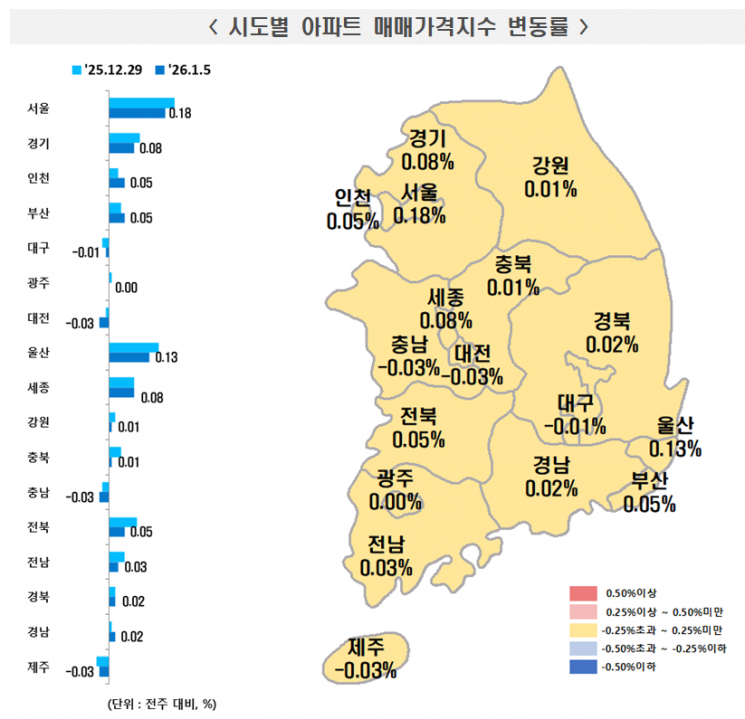 Apartment Sales Price Index Change Rate by City and Province in the First Week of January. Korea Real Estate Board
Apartment prices in Gyeonggi Province rose by 0.08%, marking the second consecutive week of slowing growth (from 0.12% to 0.10% to 0.08%).
However, areas designated as regulated zones (adjustment target areas and speculative zones) and land transaction permit zones under the October 15 measures last year continued to show relatively strong performance.
Suji District in Yongin rose by 0.42%. Although the growth rate has slowed for two consecutive weeks (from 0.51% to 0.47% to 0.42%), it remains the highest among regulated areas. Bundang District in Seongnam (from 0.44% to 0.32% to 0.31%) also saw its growth rate slow but still maintained a high level. Gwangmyeong City (from 0.26% to 0.28%), Hanam City (from 0.19% to 0.23%), and Paldal District in Suwon (from 0.08% to 0.20%) saw their growth rates increase.
In contrast, Gwacheon City (0.24%) and Dongan District in Anyang (0.23%) saw their growth rates decrease for the fourth consecutive week. Both Gwacheon City and Dongan District in Anyang saw their growth rates drop to about half compared to the second week of December (0.45% and 0.42%, respectively).
Incheon rose by 0.05%, up from the previous week (0.03%). It was the only area in the greater Seoul metropolitan region to see an increase in the growth rate in the first week of the new year.
Overall, the greater Seoul metropolitan area rose by 0.11%, a slight slowdown compared to the previous week (0.12%).
Jeonse Market Supply Shortage Continues... Seocho District Surges 0.36%
Nationwide apartment jeonse prices rose by 0.08%, a smaller increase than the previous week (0.09%).
However, Seoul still recorded a high growth rate at 0.14%. The Korea Real Estate Board stated, "Demand for leases continues to focus on large-scale and station-area complexes, while the supply shortage of listings persists."
By district, Seocho recorded the highest increase at 0.36%, followed by Gangdong at 0.22%. Gyeonggi Province (0.10%) and Incheon (0.11%) also saw increases.
© The Asia Business Daily(www.asiae.co.kr). All rights reserved.


















