Four Rounds of Work Reports to Review Key Tasks and Implementation Plans
Comprehensive Assessment Across All Sectors Including Resources, Exports, Safety, and RE100 Industrial Complexes
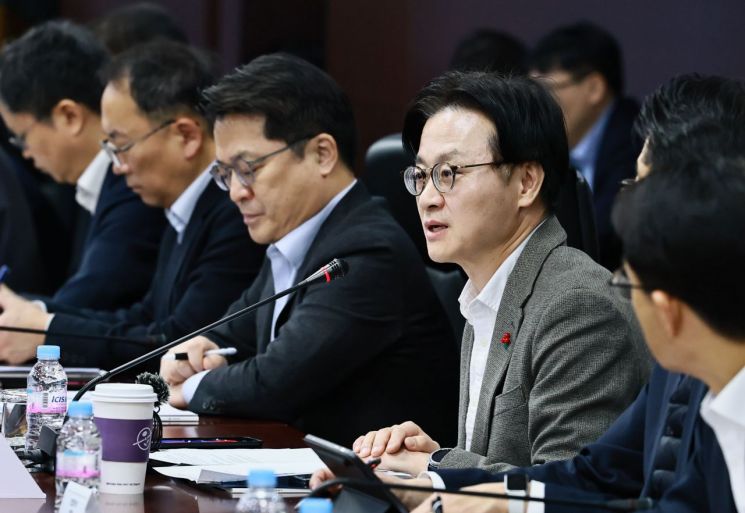 Kim Jeong-Kag, Minister of Trade, Industry and Energy, is delivering opening remarks at the Ministry of Trade, Industry and Energy public institutions (gas and nuclear power export sector) work report held on the afternoon of the 8th at the Korea Trade Insurance Corporation conference room in Jongno-gu, Seoul. Photo by Ministry of Trade, Industry and Energy
The Ministry of Trade, Industry and Energy will receive work reports from over 20 public institutions and related organizations in four sessions from January 8 to 12. This initiative aims to review the key tasks and implementation plans of affiliated public institutions and to strengthen oversight and supervision to deliver outcomes that the public can directly experience.
Minister Kim Jeong-Kwan will personally preside over all sessions of the work report meetings, with the Vice Minister, directors, relevant department heads, working-level officials, and executives from each institution in attendance to closely examine response measures and implementation plans for current issues. The Ministry also plans to review the social responsibilities of public institutions, such as disaster and safety management, public communication, regional economic revitalization, and win-win cooperation, in line with the government’s core policy of public sovereignty. Any shortcomings identified during the reporting process will be subject to focused management and follow-up improvements.
This round of work reports will proceed sequentially by sector. The first session, held on January 8 at the Korea Trade Insurance Corporation’s main conference room, included public institutions in the ‘gas sector’-such as Korea Gas Corporation, Korea Gas Technology Corporation, and Korea Gas Safety Corporation-and in the ‘nuclear power export sector’-including Korea Electric Power Corporation and Korea Hydro & Nuclear Power. The meeting discussed topics such as stable management of natural gas supply, the domestic LNG cargo containment system demonstration project, and the advancement of AI-based safety management. In the nuclear power export sector, the focus was on cooperation with key countries such as Vietnam and the Czech Republic, as well as expanding joint overseas projects with the United Arab Emirates in third countries.
The second session, scheduled for January 9, will be attended by public institutions related to trade security and standards, such as the Korea Strategic Trade Institute, Korea Testing Laboratory, and Korea Product Safety Management Agency, along with associated organizations like the Korean Standards Association, Korea Industrial Technology Protection Association, and the Korea Productivity Center. This meeting will focus on issues in the trade, standards, and security sectors, including blocking illegal exports and responding to export controls, securing testing and certification capabilities for advanced industries, preventing technology leaks and strengthening security, and developing AI reliability certification.
Minister Kim emphasized, “Last year, our efforts were concentrated on resolving external uncertainties such as tariff negotiations, but this year it is time to deliver tangible results that the public and businesses can truly feel.” He added, “The Ministry and public institutions must go beyond simply dividing roles and instead work as one team to achieve results that can be presented to the public.”
On January 12, the third and fourth sessions will be held at the Korea Chamber of Commerce and Industry. The third session will involve institutions in the industrial sector, such as the Korea Industrial Complex Corporation, Korea Institute for Advancement of Technology, and Korea Institute of Industrial Technology Evaluation and Planning, to review tasks including RE100 industrial complexes and region-based manufacturing AX initiatives.
The fourth session, to be broadcast live on KTV later that day, will focus on public institutions in the resources sector-such as Korea National Oil Corporation, Korea Mine Rehabilitation and Mineral Resources Corporation, and Korea Coal Corporation-and export-related organizations like KOTRA and Korea Trade Insurance Corporation. This meeting will address a wide range of issues, including strategies to improve financial soundness, secure key minerals such as rare earth elements, and achieve $700 billion in exports for the second consecutive year, as well as overall resource security, economic revitalization, and supply chain response measures.
© The Asia Business Daily(www.asiae.co.kr). All rights reserved.

















