Mayor Oh Stresses Easing Regulations on Private Rental Housing
"Private Rental Operators Must Be Distinguished from Speculators"
Recommends Relaxing LTV Rules and Restoring Comprehensive Real Estate Tax Exemptions
Following the government's October 15 policy measures, the number of jeonse (long-term lease) listings in Seoul has plummeted, prompting the Seoul Metropolitan Government to step up efforts to revitalize the private rental housing market. The city plans to ease regulations on private rental housing operators to find a breakthrough for the current supply crunch.
On January 8, Seoul Mayor Oh Se-hoon visited the "Mangrove Sinchon" private rental housing complex in Mapo-gu and urged the government to relax regulations on private rental housing operators, stating, "The government, which should be loosening regulations to facilitate supply, is instead tightening the reins."
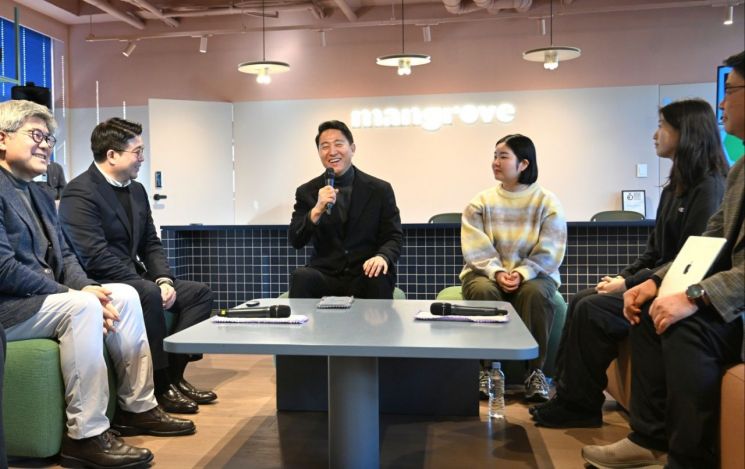 Seoul Mayor Oh Se-hoon is visiting a private rental housing site on the morning of the 8th to discuss measures to revitalize private rental housing with developers, residents, and related parties. Provided by Seoul City
Mayor Oh emphasized, "The government currently plans to secure public land for apartment construction, but it will take five to ten years before supply materializes. Meanwhile, the supply of jeonse units is decreasing and the sales market is shrinking, so we must open the door for private capital to enter the market."
He added, "Private rental housing operators specializing in development are well aware of which locations are most efficient for building new homes. If the Seoul Metropolitan Government and the central government work together with a forward-looking approach, large-scale supply can be achieved most rapidly."
At the site visit, developers pointed out that inconsistent regulatory enforcement is increasing business uncertainty. Jo Kangtae, CEO of Mangrove Sinchon, said, "Regulations on private rental housing are divided among multiple government ministries such as the Ministry of Land, Infrastructure and Transport, the Ministry of the Interior and Safety, and the Financial Services Commission, resulting in different interpretations by each ministry. Fragmented and inconsistent regulations hinder long-term business planning and investment."
Private rental housing is subject to an annual rent increase cap of 5%, mandatory lease renewal for six to ten years, and a requirement for guarantee insurance. These measures have made private rental housing a stable housing option for tenants by reducing the risk of jeonse fraud. Currently, there are 416,000 private rental housing units registered with the city, accounting for about 20% of all rental housing. Of these, 80% are non-apartment types such as officetels, multi-family housing, and urban lifestyle housing, which are highly preferred by single-person households and newlyweds.
The private rental housing market has faced difficulties due to the government's strict lending regulations and the impact of the October 15 policy package. After the September 7 supply measures, the loan-to-value (LTV) ratio for purchase-type rental housing operators was limited to 0%, effectively blocking new entrants from the market. Prospective operators must now secure the full purchase price of new rental units in cash. In addition, purchase-type rental housing is no longer excluded from the comprehensive real estate tax base, increasing the tax burden for operators.
The city believes that attracting private rental housing operators to the market is necessary to increase the supply of non-apartment housing. Since the October 15 measures restricted gap investment, the number of jeonse listings in Seoul as of November last year stood at 25,000, a 25% decrease from the previous year. Next year, only 29,000 new apartment units are scheduled for occupancy, making it urgent to find a breakthrough to ease the supply shortage.
Mayor Oh pointed out, "An LTV of 0% means operators must invest only their own capital. Private rental housing operators are being lumped together with speculative investors under the law and regulations, resulting in lending restrictions that prevent them from doing business. This needs to be addressed."
He continued, "The benefits of regulatory relaxation will go to young people who need housing. I will strongly reiterate to the government the need to ease regulations on private rental housing operators to revitalize the non-apartment market, which provides homes for one- to two-person households, young people, and newlyweds."
Previously, in October last year, the city announced a "Plan to Revitalize Registered Private Rental Housing in Seoul," promising financial support, relaxation of building regulations, and administrative support for both lessors and lessees. The city also requested the government to rationally adjust tax benefits, including easing the LTV for private rental housing operators and improving the exclusion from the comprehensive real estate tax base.
© The Asia Business Daily(www.asiae.co.kr). All rights reserved.
![Clutching a Stolen Dior Bag, Saying "I Hate Being Poor but Real"... The Grotesque Con of a "Human Knockoff" [Slate]](https://cwcontent.asiae.co.kr/asiaresize/183/2026021902243444107_1771435474.jpg)
















