Support for the "Five Poles, Three Special Zones" Balanced Development Strategy
Calls for Integrated Design of Decentralization, Industry, and Living Zones
As discussions surrounding the administrative integration of Gwangju and Jeonnam accelerate, the Joguk Innovation Party has called on the Lee Jaemyung administration to present a concrete vision and institutional support for the post-integration era. The Joguk Innovation Party stated that administrative integration is not merely a matter of adjusting boundaries, but a core task in the national balanced development strategy, and thus a clear blueprint encompassing decentralization, industrial transformation, and changes to living zones must be presented.
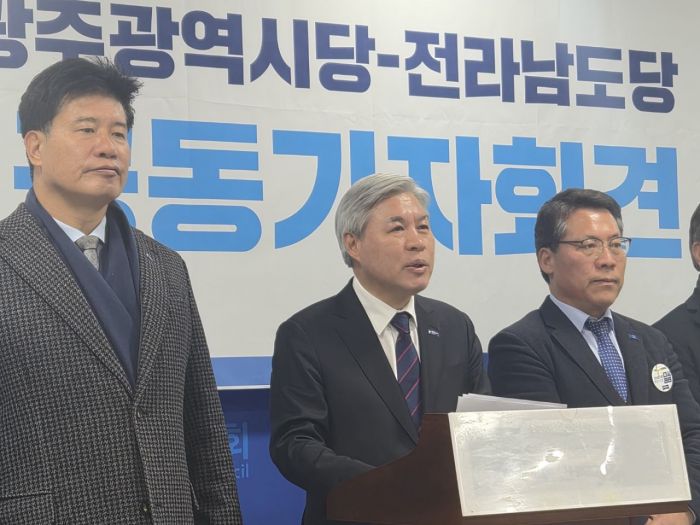 On the morning of the 8th, at the briefing room on the 3rd floor of the Gwangju Metropolitan Council, Seo Wangjin, the floor leader, and other party officials held a joint press conference of the Joguk Innovation Party Gwangju Metropolitan Party and Jeollanam-do Party to express their position on the promotion of administrative integration of Gwangju and Jeonnam. Photo by Song Bohyun
On the morning of the 8th, the Joguk Innovation Party Gwangju Metropolitan Party and Jeollanam-do Party held a joint press conference at the briefing room on the 3rd floor of the Gwangju Metropolitan Council, emphasizing, "While administrative integration should proceed swiftly, a meticulous structural design must be implemented in parallel to alleviate the concerns of city and provincial residents." The press conference was attended by Seo Wangjin, Floor Leader and Chair of the Gwangju Metropolitan Party, and Park Heunggu, Acting Chair of the Jeollanam-do Party.
In its press statement, the Joguk Innovation Party diagnosed that the dominance of the capital region is deepening regional alienation and stagnation, which poses a crisis threatening the sustainability of the entire nation, beyond mere regional disparities. The party expressed strong agreement with the Lee Jaemyung administration's "Five Poles, Three Special Zones" national balanced development strategy, describing it as "a national survival solution."
The party argued that the administrative integration of Gwangju and Jeonnam should be pursued within the framework of "three major transformations." First, they proposed a fundamental shift toward decentralization. Integration should not just be about scaling up, but should serve as an effective model for advancing toward a decentralized nation, with a significant strengthening of autonomy in finance, administration, organization, and personnel. To this end, they called for the (tentative) Gwangju-Jeonnam Ultra-Wide Special Metropolitan City Special Act to clearly guarantee autonomy and fiscal independence equivalent to that of Seoul Metropolitan City, and urged the National Assembly to expedite its passage.
Second, the party emphasized the need for industrial transformation. Referring to President Lee Jaemyung's New Year's address mentioning the Southern Semiconductor Belt, AI demonstration cities, and renewable energy clusters, they stressed that moving beyond vision statements to implementation is necessary. They argued that the semiconductor industry should be reorganized from a capital region-centric structure to a longitudinally distributed structure extending from Saemangeum in Jeonbuk to Gwangju and Jeonnam. For this, they called for a strategic incentive package combining corporate tax reductions, tax support, and regulatory exemptions.
Furthermore, the party demanded that the national strategy include a comprehensive renewable energy industrial cluster in Gwangju and Jeonnam, integrating secondary batteries, offshore wind power substructures and equipment, and renewable energy-related materials, parts, and equipment industries, to enable the region to become not just a producer but an industrial hub for renewable energy. They also highlighted the need to redesign educational infrastructure to prevent talent outflow, proposing the establishment of university, research, and demonstration campus models specialized in artificial intelligence in Gwangju and Jeonnam.
Third, they called for a transformation in the structure of living zones. They stressed that the effectiveness of administrative integration must be proven not by institutions, but in the daily lives of citizens, and that the design should focus on living zones rather than administrative boundaries. In particular, to resolve inconveniences in transportation and healthcare caused by the boundaries between Gwangju and Jeonnam cities and counties, they urged a comprehensive review of the metropolitan transportation network and national transportation plans, aiming for a "30-minute commute zone for Gwangju and a 1-hour commute zone for Jeonnam."
To practically advance these transformations, the Joguk Innovation Party officially proposed the establishment of a "Gwangju-Jeonnam Administrative Integration Bipartisan Council" to the government and local authorities. They stated that administrative integration must not be the task of a single party, but a structure in which all parties and citizens participate, in order to secure social trust and legitimacy.
The Joguk Innovation Party stated, "President Lee Jaemyung must present a tangible vision of how citizens' lives will change after the integration of Gwangju and Jeonnam," adding, "In line with the principle that great sacrifice deserves great reward, a distinctly different and certain future must be promised in terms of decentralization, industry, and the lives of citizens." The party further pledged, "We will remain committed to ensuring that administrative integration becomes a grand transformation for citizens' lives, not just a political event."
© The Asia Business Daily(www.asiae.co.kr). All rights reserved.

















