Parallel Financial Support for SMEs and Investment Attraction...
Launching Strategies to Transform the Industrial Landscape
Improving Industrial Complex Infrastructure and Expanding Investment Attraction...
Seeking to Reshape the Future Industrial Map
Amid prolonged high exchange rates and inflation, as well as uncertainty in the global trade environment, the resilience of local industries is being put to the test.
Gyeongju City has sought to shift its industrial policy direction by simultaneously expanding financial support for small and medium-sized enterprises (SMEs), improving industrial infrastructure, and attracting global investment, particularly leveraging the APEC summit.
The key is to move beyond short-term crisis response and transform from a "surviving industry" to a "scaling-up industry."
This approach, which encompasses finance, investment, and industrial infrastructure, also serves as an experiment to restructure the local industrial landscape.
Through this special report, we will examine the achievements of Gyeongju City's industrial policies and its post-APEC strategies through three key themes. <Editor's Note>
◆ Focus on Financial Support and Business Stability for SMEs
Gyeongju City assessed the past year as a period focused on strengthening the management stability and resilience of local SMEs.
Amid worsening external conditions such as increased U.S. automotive tariffs, high exchange rates, and inflation, the city prioritized financial support policies that directly reduce the burden on companies.
Last year, Gyeongju City provided working capital loans totaling 240.4 billion won-the largest amount among cities and counties in North Gyeongsang Province.
More than 600 companies benefited from interest subsidies, helping them manage cash flow despite rising raw material prices and financial costs.
Building on this, the city plans to secure an additional 24.2 billion won this year, expanding total loan support to 264.6 billion won and continuing its efforts to ease the financial burden on SMEs.
In addition to short-term support, policies that underpin overall business management are being implemented. The city is investing 2.3 billion won in 10 business support projects, including fire insurance subsidies and improvements to dormitory environments, to enhance working conditions and safety.
Furthermore, to nurture 105 local SMEs and venture companies, the city plans to establish a 1.5 billion won Local Era Venture Fund and a 1 billion won G-Star North Gyeongsang Potential Fund, thereby providing support systems tailored to each stage of growth.
Joo Nakyoung, Mayor of Gyeongju, stated, "We designed our policies not just to overcome crises, but to enable companies to prepare for their next investments," adding, "We focused on making a tangible impact at the grassroots level."
◆ Expanding Industrial Scope through Regulatory Easing and APEC
Visible achievements have also been made in attracting investment.
Last year, Gyeongju City attracted investments totaling 236.6 billion won from nine companies, including returning domestic firms such as Hyundai MCIT, companies relocating from the Seoul metropolitan area, and high-potential small and medium-sized enterprises.
This resulted in the creation of over 390 new jobs, contributing to the expansion of the local employment base.
Institutional improvements were also made to enhance the effectiveness of investment attraction.
The support limit for new and expanded corporate facilities was raised to a maximum of 5 billion won, and the minimum requirement for new regular employment related to investment attraction was relaxed to 10 employees, lowering entry barriers for businesses.
Additionally, a new logistics cost support program was introduced, providing up to 30 million won to help reduce the actual costs incurred during business operations.
In particular, the 2025 APEC Summit served as a catalyst for expanding the industrial scope of Gyeongju.
Through the North Gyeongsang Province Investment Forum and investment briefings targeting 21 APEC member economies, the city highlighted the competitiveness of the SMR National Industrial Complex and Gyeongju's industrial location advantages.
The participation of local companies in events such as the Korean Chamber of Commerce and Industry CEO Summit and Summer Forum symbolically demonstrated the growing connection between the local industry and the global stage.
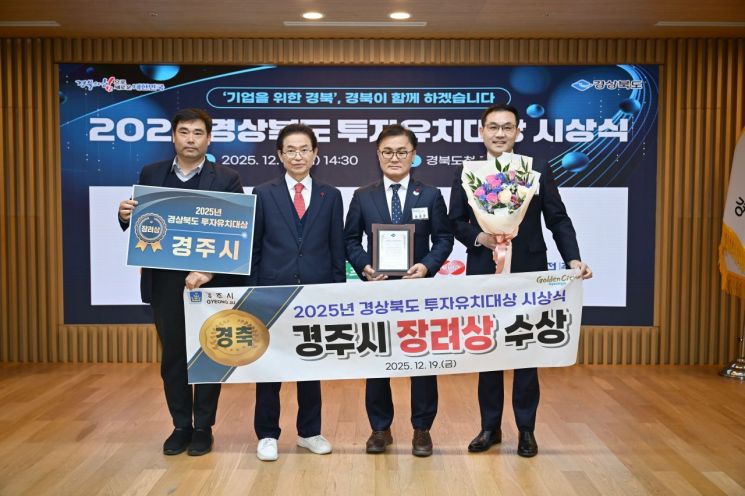
Based on these achievements, Gyeongju City received the Encouragement Award for Investment Attraction from North Gyeongsang Province and was recognized as an outstanding institution for SME development policies.
◆ Post-APEC Industrial Map and Major Transformation of Industrial Complexes
Gyeongju City has designated this year as the official starting point for its post-APEC industrial strategy.
With a total investment of 400 million won, the city is collaborating with North Gyeongsang Province and KOTRA to dispatch investment promotion delegations to APEC member economies such as the United States and Canada, and to hold a series of investment briefings in Korea, China, and Japan.
Through these efforts, Gyeongju City aims to attract follow-up investments totaling 1 trillion won.
Improvements to the industrial field are also being pursued simultaneously.
Last year, the city invested 3.5 billion won to resolve more than 120 issues in 35 industrial and agro-industrial complexes and 11 individual complexes, including the creation of public parking lots, maintenance of roads and convenience facilities, and improvements to access roads in Seomyeon, Gangdong-myeon, and Seocheon, thereby addressing logistics and flood-related complaints.
This year, an additional 4.3 billion won will be invested to continue improving industrial infrastructure, focusing on Geoncheon 2 General Industrial Complex, Mohwa Complex, and Oedong Agro-Industrial Complex.
In Oedong Industrial Complex, a multi-purpose cultural center and a beautiful street project, both promoted as part of a Ministry of Trade, Industry and Energy public offering, will be completed in the first half of this year.
This is expected to establish the image of a cultural industrial complex where young workers want to stay, while also alleviating indiscriminate parking problems.
Additionally, the city plans to compete for the 63.8 billion won "Culture Leading Industrial Complex" project, aiming to transform aging industrial complexes into innovative spaces where industry and culture converge.
In the long term, gaps in the industrial map will also be addressed. Gyeongju City plans to directly develop a dedicated e-mobility industrial complex in the northern Angang region, where industrial infrastructure is relatively weak, by investing more than 60 billion won by 2030 in conjunction with the government's RE100 wind power project.
Mayor Joo Nakyoung emphasized, "The challenge is to translate Gyeongju's elevated international status, achieved through APEC, into industrial achievements," adding, "We will boldly invest in areas lacking industrial infrastructure and reshape Gyeongju's industrial landscape into complexes that attract young people."
© The Asia Business Daily(www.asiae.co.kr). All rights reserved.

![Clutching a Stolen Dior Bag, Saying "I Hate Being Poor but Real"... The Grotesque Con of a "Human Knockoff" [Slate]](https://cwcontent.asiae.co.kr/asiaresize/183/2026021902243444107_1771435474.jpg)















