China Likely to Tighten Export Controls on Dual-Use Materials
Including Rare Earths Bound for Japan
Japan's Dependence on Chinese Rare Earths Exceeds 70%
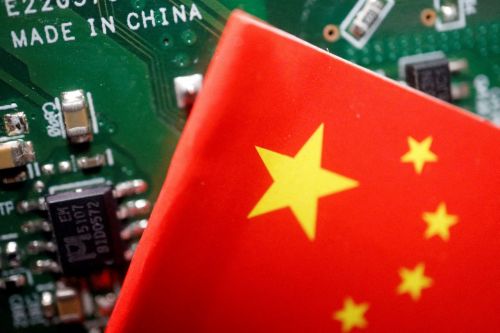
As China has tightened export controls on dual-use materials, including rare earth elements, in response to Japanese Prime Minister Sanae Takaichi's remarks suggesting possible intervention in the event of a Taiwan contingency, anxiety is spreading throughout Japan's industrial sector.
According to the Asahi Shimbun on January 8, at a New Year's event held in Tokyo the previous day by the Japan-China Economic Association and others, Chairman Kosei Shindo stated, "The curtain has risen on the new year under extremely difficult circumstances." Luo Xiaomei, Minister for Economic and Commercial Affairs, who attended in place of Chinese Ambassador to Japan Wu Jianghao-who was absent in an unusual move-said, "Currently, Japan-China relations are facing the most serious situation since the normalization of diplomatic ties."
The Chinese government is considering strengthening its export permit review for certain rare earth-related items destined for Japan. Chinese state media reported that seven heavy rare earth elements-samarium, gadolinium, terbium, dysprosium, and others-classified as dual-use materials in April last year in response to the Donald Trump administration's tariff measures, are highly likely to be subject to export restrictions.
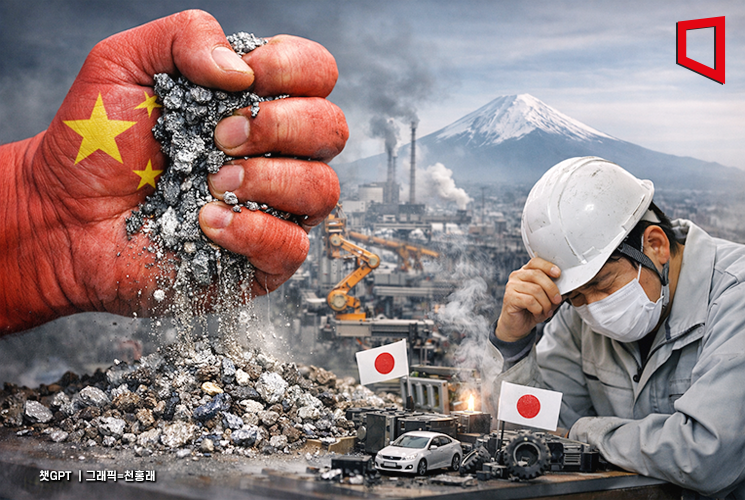
Japan currently depends on China for 70% of its rare earth supply. Japan's dependence on Chinese rare earths dropped to 58% in 2020, but rose again to 72% in 2024 due to increased demand.
An executive at a Japanese automobile company told the Yomiuri Shimbun, "If the supply becomes unstable again, we may have to reduce production." Toshimitsu Imai, President of Toyota Tsusho, emphasized that if China bans rare earth exports, it would become a truly serious issue, stating, "South Korea, the United States, and Japan must respond on a national scale."
Takahide Kiuchi, a researcher at Nomura Research Institute, predicted that if China were to impose full-scale rare earth export restrictions for one year, Japan's economic losses could reach approximately 2.6 trillion yen (about 24 trillion won).
Japan is working to diversify its rare earth import sources to countries such as Australia and is pursuing test drilling for rare earth elements in waters near Minamitorishima in the Pacific. However, the prevailing view is that these measures are still insufficient.
The Mainichi Shimbun reported, "Cooperation to strengthen critical mineral supply chains with countries including the United States has not yet fully materialized, and the development of products and technologies to reduce dependence on rare earths is still ongoing." The newspaper predicted that if China implements a rare earth export ban, it will not be easy for Japan to find solutions.
In particular, there is a growing assessment within the Japanese government that China has expanded the front lines. Attention is being drawn to the fact that one of the purposes of this measure is said to be "the enhancement of Japan's military capabilities."
The Mainichi Shimbun noted that China announced a ban on the export of all dual-use materials that could be used for Japanese military purposes or contribute to the enhancement of military capabilities. The newspaper pointed out, "The core of this measure is how broadly the scope of 'dual-use' is interpreted," and assessed that China has left room to include rare earths used for civilian purposes as well.
© The Asia Business Daily(www.asiae.co.kr). All rights reserved.
![From Bar Hostess to Organ Seller to High Society... The Grotesque Con of a "Human Counterfeit" [Slate]](https://cwcontent.asiae.co.kr/asiaresize/183/2026021902243444107_1771435474.jpg)

















