Eight Global IBs Raise US Growth Forecast to 2.3% in One Month
Korea Holds at 2.0%... Gap Widens Further
Eight major global investment banks (IBs) have raised their forecasts for the United States' real gross domestic product (GDP) for this year within just one month. In contrast, their economic growth outlook for South Korea has remained unchanged. As a result, the growth rate gap between the US and South Korea has widened from the previous 0.1 percentage points to 0.3 percentage points. This suggests that South Korea's growth rate is expected to fall below that of the US again this year, a situation that could serve as a factor driving up the KRW-USD exchange rate.
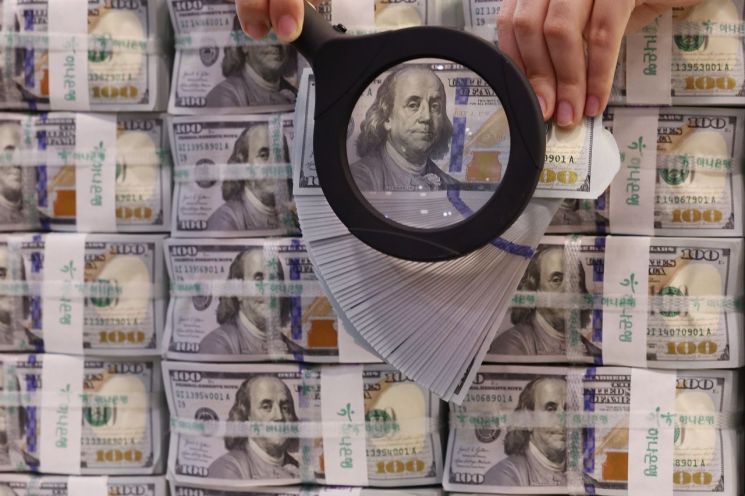 An employee is holding up US dollars at the Counterfeit Response Center of KEB Hana Bank in Myeongdong, Jung-gu, Seoul. Photo by Yonhap News
According to the International Finance Center on January 8, the average growth forecast for the United States this year, as projected by eight major IBs at the end of December 2025, was 2.3 percent. This is an increase of 0.2 percentage points compared to one month earlier.
This upward revision is the result of six out of the eight institutions raising their growth forecasts. Specifically, Goldman Sachs (2.5% to 2.7%), Nomura (2.4% to 2.6%), Citi (1.9% to 2.2%), Barclays (2.1% to 2.2%), UBS (1.7% to 2.1%), and JP Morgan (2.0% to 2.1%) all raised their projections.
The upward adjustments in growth forecasts are attributed to continued investment expansion, the effects of tax cuts and interest rate reductions, and expectations that, based on these factors, robust growth will continue not only in artificial intelligence (AI) but also in other sectors.
On the other hand, the average growth forecast for South Korea remained unchanged at 2.0 percent at the end of December, the same as in November.
Bank of America (BOA) raised its forecast from 1.6 percent to 1.9 percent, and HSBC from 1.7 percent to 1.8 percent. However, Goldman Sachs lowered its projection from 2.2 percent to 1.9 percent, resulting in the average remaining the same.
Accordingly, the growth rate gap between the US and South Korea as projected by global IBs widened from 0.1 percentage points at the end of November 2025 to 0.3 percentage points in just one month. However, it is expected that this year's gap will be somewhat narrower than last year's gap of 1.0 percentage point.
The growth rate gap between the US and South Korea is considered, along with the interest rate differential, a major factor behind the weakness of the Korean won. While the interest rate gap can directly and immediately trigger capital outflows by both foreign and domestic investors, the growth rate affects economic fundamentals and investor sentiment, potentially having a long-term impact. The annual reversal in growth rates between the US and South Korea has continued since 2023.
© The Asia Business Daily(www.asiae.co.kr). All rights reserved.

















