Mounjaro and Wegovy Top 50 Trillion Won in Sales Last Year
13-14% Higher Than Keytruda
This Year’s Obesity Trends: Oral Formulations and Amylin Combination Therapy
Obesity treatments, represented by Wegovy and Mounjaro, have surpassed Keytruda (an anticancer drug), which had long held the top spot for global pharmaceutical sales.
According to a report released by Eugene Investment & Securities on January 8, based on Bloomberg consensus and the company's own estimates, products containing tirzepatide (marketed as Mounjaro and Zepbound) from Eli Lilly recorded sales of $35.8 billion (approximately 51.93 trillion won) in the previous year. Meanwhile, products containing semaglutide (marketed as Ozempic, Wegovy, and Rybelsus) from Novo Nordisk posted sales of $35.6 billion (about 51.64 trillion won).
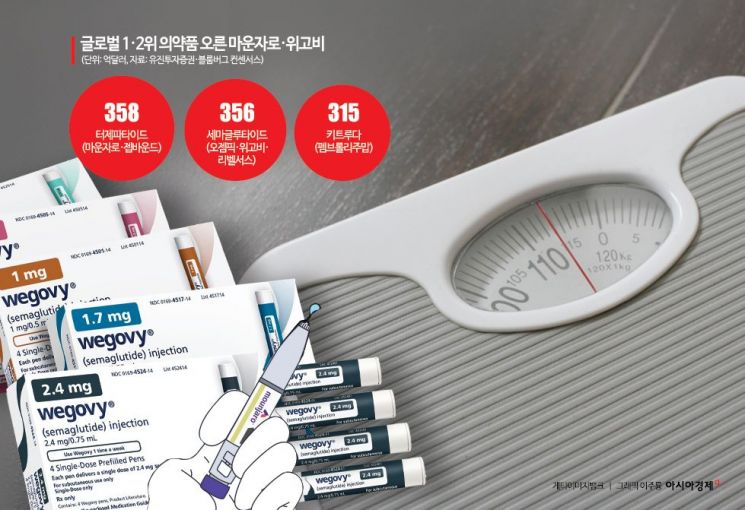
This figure exceeds the $31.5 billion (about 45.69 trillion won) in sales of Keytruda, Merck’s immuno-oncology drug, which had maintained the number one position in global pharmaceutical sales since 2023, by 13-14%. The report noted, "As both compounds expand beyond obesity into broader metabolic diseases such as diabetes and cardiovascular risk management, their demand base has widened. Combined sales of these two compounds surpassed $70.5 billion last year, exceeding 100 trillion won. This signals a structural shift in the blockbuster pharmaceutical landscape, with obesity and metabolic disease treatments reshaping a market previously dominated by anticancer drugs."
The next major battleground in the market is the shift from injectable drugs to oral medications. Eugene Investment & Securities projected continued growth in the obesity treatment market this year, defining it as a "multi-transition period" characterized by the introduction of oral drugs, expansion of combination therapies, increased pricing and reimbursement pressures, and patent expirations in certain regions. In December of last year, Novo Nordisk’s oral semaglutide (25mg) received approval from the U.S. Food and Drug Administration (FDA), and Eli Lilly has completed its FDA submission for its oral obesity treatment, orforglipron. If oral formulations become widely adopted, some analysts predict that oral drugs could account for around 30% of the obesity and metabolic disease treatment market by around 2030.
This trend toward "oral drug conversion" is immediately evident in the deal strategies of major pharmaceutical companies. On the previous day, Eli Lilly signed a research collaboration agreement worth up to $1.3 billion (about 1.89 trillion won) with U.S. biotech company Nimbus Therapeutics, aiming to develop new oral treatments for metabolic diseases, including obesity. Under the agreement, Nimbus will use its artificial intelligence (AI)-based design capabilities to identify candidate substances, while Lilly will leverage its clinical, development, and commercialization expertise in metabolic diseases to enhance its competitiveness in "oral obesity drugs."
Research and development (R&D) is also shifting toward "amylin" and combination therapies. Amylin is a peptide hormone secreted by pancreatic beta cells after meals, alongside insulin. It moderates postprandial blood glucose increases and enhances satiety, thereby reducing food intake. Eugene Investment & Securities stated, "The commercial appeal of GLP-1RA (glucagon-like peptide-1 receptor agonist) standalone injectable pipelines may gradually weaken from the R&D stage," explaining, "This is why Novo Nordisk is pursuing the launch of 'CagriSema,' which combines GLP-1RA with an amylin analogue, in the second half of this year." Roche has also licensed the amylin analogue petrelintide from Zealand Pharma to develop an amylin-based obesity treatment, and AbbVie has acquired the amylin analogue 'GUB014295' from Gubra. This trend reflects a shift in the weight loss drug market from "medications that lose more weight" to "therapies that maintain weight loss safely over the long term." In the long-term use market, oral drugs that improve convenience and adherence, as well as combination and novel mechanism therapies that address body composition and side effect profiles, are emerging simultaneously.
© The Asia Business Daily(www.asiae.co.kr). All rights reserved.
![Clutching a Stolen Dior Bag, Saying "I Hate Being Poor but Real"... The Grotesque Con of a "Human Knockoff" [Slate]](https://cwcontent.asiae.co.kr/asiaresize/183/2026021902243444107_1771435474.jpg)
















