Last year, Gyeonggi Province recorded its best air quality to date.
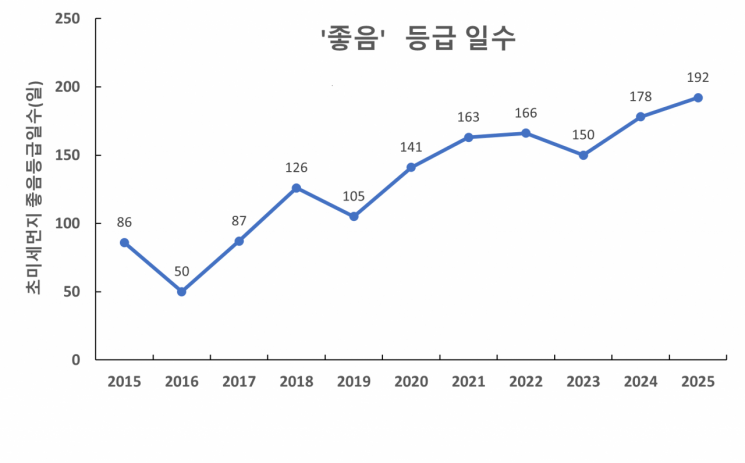
According to the Gyeonggi Institute of Health and Environment on January 8, the province's annual average concentration of fine particulate matter (PM-2.5) in 2025 was 18㎍/㎥, with 192 days classified as "good"-the highest number of clear air days since measurements began in 2015.
The annual average PM-2.5 concentration in Gyeonggi Province decreased from 26㎍/㎥ in 2019 to 21㎍/㎥ in 2020, 21㎍/㎥ in 2021, and 20㎍/㎥ in 2022. It then recorded 21㎍/㎥ in 2023, and continued its downward trend with 18㎍/㎥ in both 2024 and 2025.
Measurements from 111 urban air monitoring stations across 31 cities and counties showed that the number of "good" air quality days for fine dust reached 192 in 2025, an increase of 14 days compared to the previous record of 178 days in 2024. According to air quality standards, a PM-2.5 concentration of 15μg/m3 or lower is classified as "good."
By city and county, Pyeongtaek, Gimpo, Anseong, and Yeoju recorded the highest annual average PM-2.5 concentration at 20㎍/㎥. Dongducheon recorded the lowest in the province at 13㎍/㎥. Dongducheon has maintained the lowest PM-2.5 concentration in Gyeonggi Province for four consecutive years since 2022. Ansan saw the largest year-on-year increase among the 31 cities and counties, with a rise of 2㎍/㎥.
Based on these findings, the provincial Institute of Health and Environment plans to publish the "2025 Gyeonggi Province Air Quality Assessment Report" in the second half of this year, following a review by the National Institute of Environmental Research. The air quality analysis results will be released to residents through the Air Environment Information Service website (air.gg.go.kr).
Kim Mijeong, head of the Air Monitoring Network Team at the provincial Institute of Health and Environment, stated, "The improvement in air quality can be attributed to the implementation of policies across industry, transportation, and daily life sectors, as well as relatively favorable weather conditions. However, high concentrations of fine dust may still occur due to changes in weather and external factors such as yellow dust. I urge residents to take special care of their health by limiting outdoor activities when air pollution alerts are issued."
© The Asia Business Daily(www.asiae.co.kr). All rights reserved.


















