Recently announced Chinese export restrictions on dual-use goods to Japan are intended to pressure Japanese Prime Minister Sanae Takaichi and to curb Japan's military buildup, according to analysis from Chinese academic circles, which highlight the security objectives behind the move.
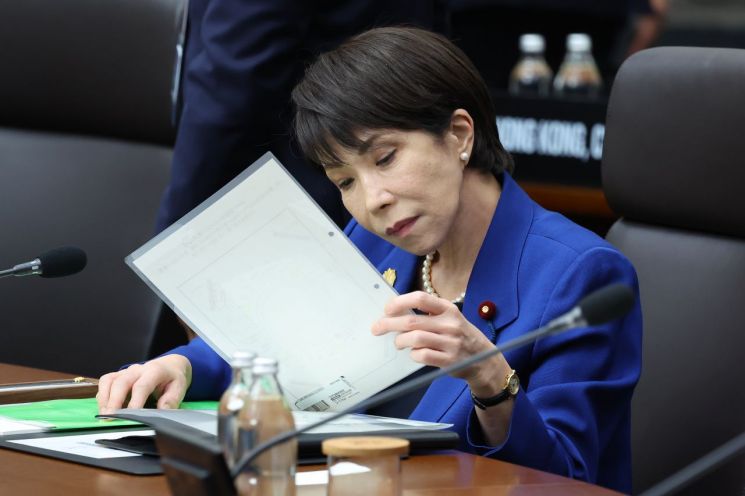 Sanae Takaichi, Prime Minister of Japan, is attending the first session of the 2025 Asia-Pacific Economic Cooperation (APEC) Summit held at Gyeongju HICO Convention Center on October 31 last year. Photo by Yonhap News
On January 7, Jin Canrong, a professor at the School of International Studies at Renmin University of China, stated on his social media account, "The Chinese Ministry of Commerce's export ban on dual-use goods is an escalation of economic sanctions," explaining the situation in these terms.
He said, "There are clearly two objectives behind these sanctions. One is a political aim to pressure the Takaichi administration to retract its 'remarks.' Prime Minister Takaichi has been trying to weather the situation and gloss over it, but ultimately has not clearly acknowledged that Taiwan is part of China," he criticized.
Professor Jin continued, "The second objective is to prevent Japan's military capabilities from improving rapidly and comprehensively."
He argued, "As a result of these sanctions, there will be things Japan is no longer able to produce, and in such cases, it will have no choice but to rely on the United States. This will significantly undermine Japan's 'strategic autonomy.'" He further predicted, "In the end, Japan's autonomy will be weakened, and the country will remain in a system with the vulnerability of being unable to establish a complete military structure like China or the United States."
Previously, the 'Junzhengping' social media account, operated by the People's Liberation Army News Dissemination Center, also stated that the Ministry of Commerce's export ban was a response to Japan's moves to strengthen its military capabilities.
Junzhengping explained, "This measure is not only to safeguard national security and interests, but also helps to curb the trend of military buildup in the Asia-Pacific region."
© The Asia Business Daily(www.asiae.co.kr). All rights reserved.

















