The National Assembly's Legislation and Judiciary Committee has referred the second comprehensive special prosecutor bill regarding the December 3 Martial Law Incident, as well as the special prosecutor bill on the Unification Church, to the Agenda Coordination Committee, led by the ruling party.
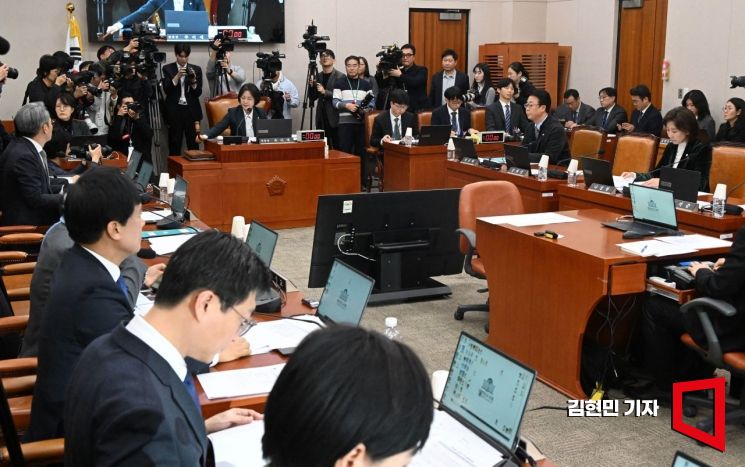 Choo Mi-ae, Chairperson of the National Assembly's Legislation and Judiciary Committee, is striking the gavel at the plenary meeting of the Legislation and Judiciary Committee held at the National Assembly on January 7, 2026. Photo by Kim Hyunmin
On January 7, the committee convened a plenary meeting, introduced the special prosecutor bills, and, at the request of the Democratic Party of Korea, referred these bills to the coordination committee.
Typically, bills are reviewed by a subcommittee after being introduced at the plenary meeting. However, if there are significant disagreements, a coordination committee may be formed for review at the request of at least one-third of the members.
The Democratic Party's decision to opt for the coordination committee process is seen as an attempt to bypass the subcommittee, which usually operates based on bipartisan agreement, and instead expedite the review through a vote in the coordination committee. This is because, under the National Assembly Act, a bill approved by the coordination committee is considered to have passed the subcommittee review.
The coordination committee approves bills with the consent of at least two-thirds of its six members. Currently, the Democratic Party and its allied parties hold four of the six seats in the Legislation and Judiciary Committee.
The comprehensive special prosecutor bill introduced on this day designates as investigation targets former President Yoon Suk-yeol's declaration of martial law on December 3, charges of insurrection, and charges of foreign exchange and military rebellion. It also includes allegations of complicity by national and local government agencies in the martial law, as well as the specific planning and preparation of the so-called "Noh Sangwon Notebook" contents.
Other investigation targets include suspicions that, before and after the 2022 presidential election, former President Yoon and his spouse operated an illegal election campaign or engaged in transactions with religious groups such as the Unification Church; as well as allegations that, during the 2022 local elections and the 2024 general elections, Yoon, his spouse, and Jeon Seong-bae (known as Geonjin Bopsa) were involved in nomination deals and other forms of election interference.
The special prosecutor bills on the Unification Church, proposed separately by the Democratic Party, the People Power Party and Reform Party, and the Cho Kuk Innovation Party, were also sent to the coordination committee. The Democratic Party's bill includes not only the Unification Church but also suspicions of political interference by Shincheonji as investigation targets, and grants the authority to recommend special prosecutors to the Korean Bar Association, the Korean Association of Law Professors, and the Council of Law Schools.
The bill by the People Power Party and the Reform Party includes, in addition to suspicions involving the Unification Church and politicians, allegations that Special Prosecutor Min Junggi concealed related cases, and grants the authority to recommend special prosecutors to the Chief Justice of the National Court Administration.
The Innovation Party's bill grants the authority to recommend special prosecutors to negotiation blocs and the Innovation Party, but stipulates that any party to which a suspect belongs is excluded from making recommendations.
During the meeting, Democratic Party lawmaker Lee Sungyun stated, "The public is outraged and is demanding a swift second comprehensive special prosecutor investigation to uncover the truth," adding, "We must pass this bill with lightning speed." He further urged, "Just as the death penalty was sought and sentenced for Chun Doo-hwan, the predecessor in insurrection, the same must be done for Yoon Suk-yeol, his successor."
Jeon Hyunhee, another lawmaker from the Democratic Party, also emphasized, "There are still truths that have not been revealed, and there are many aspects of the investigation that remain insufficient. The special prosecutor must clearly uncover the facts."
On the other hand, People Power Party lawmaker Joo Jinwoo argued, "A special prosecutor requires a significant budget and the dispatch of a large number of prosecutors and investigators. If so many personnel are diverted, it will hinder the investigation of cases affecting people's livelihoods, which directly harms the public. The Legislation and Judiciary Committee must thoroughly debate and review these bills."
The committee is considering convening the coordination committee as early as January 12 to vote on the comprehensive special prosecutor bill and others. After approval at the plenary meeting, if the committee review is completed, the bills are expected to be introduced at the main session scheduled for January 15.
© The Asia Business Daily(www.asiae.co.kr). All rights reserved.

















