MOU Signed to Establish Super-Regional Cooperation System
Joint Program Development and Project Discovery
"Fostering Talent Beyond Regional Boundaries"
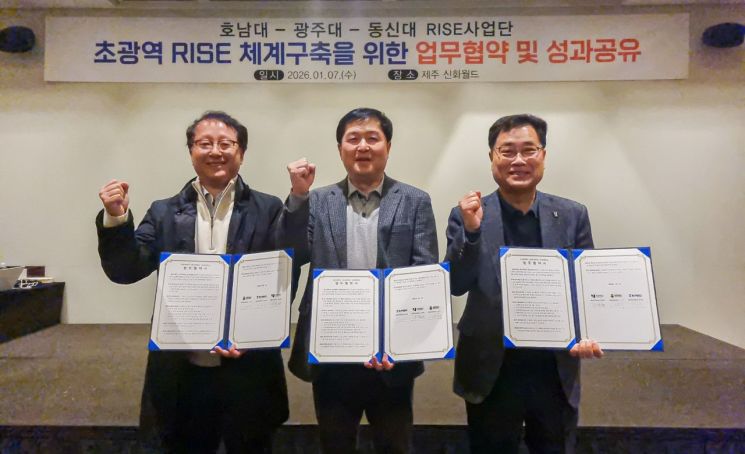 The RISE Project Groups of Dongshin University, Gwangju University, and Honam University, three universities, signed a Memorandum of Understanding (MOU) on the 7th to establish a super-regional cooperation system based on regional innovation and to promote sustainable regional development. Provided by Dongshin University
As the push for administrative integration between Gwangju and South Jeolla Province gains momentum, three private universities-Dongshin University, Honam University, and Gwangju University-have agreed to join forces for the successful establishment of the RISE (Regional Innovation-led University Support System) project and for the co-development of the Gwangju-South Jeolla super-regional area.
The RISE Project Groups of Dongshin University, Gwangju University, and Honam University announced on the 7th that they had signed a Memorandum of Understanding (MOU) to establish a super-regional cooperation system based on regional innovation and to promote sustainable regional development.
This agreement was initiated as a proactive response to the "Super-Regional Five Poles, Three Special Zones" development strategy presented at a field meeting hosted by the Minister of Education on December 19. At that time, the Ministry of Education announced plans to focus support on a "talent development-jobs-settlement" package centered around five major super-regional zones (Five Poles) and three special autonomous zones (Three Special Zones) to counterbalance the capital region.
The three universities, including Dongshin University, aim to overcome the crisis of regional extinction and secure competitiveness through bold solidarity and cooperation that breaks down barriers between institutions.
At the signing ceremony, the heads of each university's RISE Project Group and working-level officials attended to discuss specific cooperation measures. Through the agreement, the three universities pledged to collaborate on: ▲ developing and operating joint super-regional programs; ▲ establishing a university-industry-research collaboration system and identifying joint projects; ▲ jointly planning and implementing solutions to regional issues based on Living Labs; and ▲ building a system for sharing RISE project outcomes and discovering and disseminating best practices.
In particular, this agreement is significant in that it goes beyond a mere declarative statement and aims to realize a practical "shared university" model. The three universities plan to combine their specialized strengths to jointly design curricula, while sharing research equipment and facilities to prevent redundant investments and maximize investment efficiency.
In a joint statement, the heads of the three RISE Project Groups said, "In the face of a declining school-age population and rapidly changing industrial structures, the survival of universities depends not on 'every man for himself,' but on 'co-growth.' Starting with this agreement, we will focus our efforts on fostering practical talent needed by local communities and businesses, transcending boundaries between universities and regions, and creating a virtuous cycle ecosystem where these achievements lead to local settlement."
Kang Daeheung, Head of the Dongshin University RISE Project Group, emphasized at the signing ceremony, "The significance of this three-university collaboration lies in the fact that universities are taking the lead in breaking down barriers and presenting a new solution-'super-regional alliance'-in the face of the crisis of regional extinction."
Meanwhile, the three universities plan to form a working-level council in the future to establish a roadmap for the areas covered by the agreement and to enhance the effectiveness of their collaboration through quarterly performance-sharing meetings.
© The Asia Business Daily(www.asiae.co.kr). All rights reserved.

















