Mayor Kang: "A 40 Billion Won Budget Needed for Resident Referendum"
Mentions Alternative Methods Such as Council Consent for Gathering Public Opinion
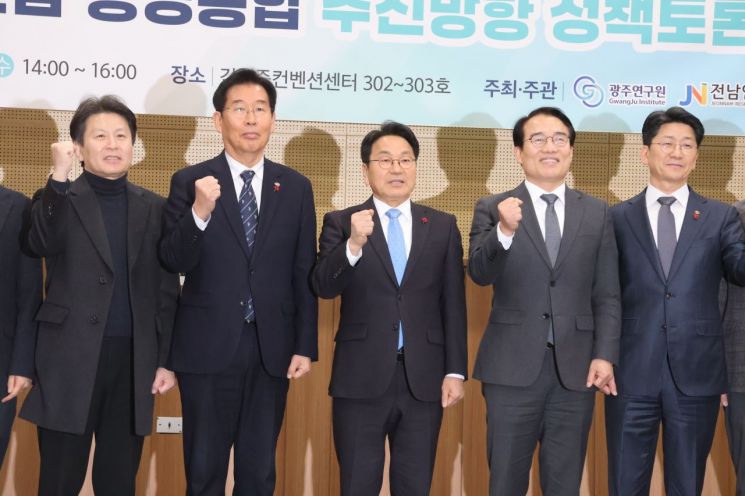 On the afternoon of the 7th, at the Kim Daejung Convention Center in Gwangju, participants including Gwangju Mayor Kang Gijeong, Gwangju Institute Director Choi Chiguk, and Jeonnam Institute Director Kim Youngsun discussed the direction of administrative integration at the "Gwangju-Jeonnam Administrative Integration Promotion Policy Forum." Photo by Song Bohyun
On January 7, Gwangju Mayor Kang Gijeong stated regarding the administrative integration of Gwangju and Jeonnam, "This morning, we reviewed the procedures required to make a resident referendum possible," adding, "We concluded that, if we follow the fastest roadmap, it could even be possible before the Lunar New Year holiday."
In his congratulatory remarks at the "Policy Discussion on the Promotion Direction of Gwangju-Jeonnam Administrative Integration" held at the Kim Daejung Convention Center in Gwangju that day, Mayor Kang said, "Along with the special law, another key task is to ask the opinion of the citizens of both regions," explaining the context of his statement.
He further explained, "If a resident referendum is held, a budget of about 40 billion won will be needed," and added, "Taking into account the schedule for finalizing eligible voters for the referendum on January 8, we have reviewed the fastest possible process."
However, Mayor Kang drew a line, clarifying that a resident referendum has not yet been finalized. He said, "Even if circumstances arise that make a resident referendum impossible, we have confirmed that proceeding through town hall meetings, public opinion surveys, or public hearings, followed by a resolution by the city and provincial councils, would not significantly deviate from the scope of the law." He also mentioned the possibility of the traditional "council consent" method.
Mayor Kang stated, "Once the Gwangju-Jeonnam Integration Cooperation Council is formed, I hope a decision will be made on whether to hold a resident referendum and how to ultimately determine the opinion of the citizens of both regions."
The policy discussion was co-hosted and organized by the Gwangju Research Institute and the Jeonnam Research Institute. In his presentation, Kim Daeseong, Head of the Win-Win Cooperation Division at the Jeonnam Research Institute, said, "The fundamental premise of administrative integration is to secure greater benefits than before the integration," and emphasized, "We must create synergy by transferring authority from the central government in the fields of industry, culture, and local autonomy."
Jeonnam Governor Kim Youngrok, in a video message, stated, "Now is an opportunity that must be seized, as the Lee Jaemyung administration is strongly supporting integration," and added, "We will swiftly identify and submit the necessary administrative and financial special provisions as a legislative bill to ensure the special law on administrative integration passes by February."
© The Asia Business Daily(www.asiae.co.kr). All rights reserved.

















