White House Statement on "Use of U.S. Military"
Closed-Door Briefing Clarifies Remarks as Pressure Tactic for Negotiations
U.S. Secretary of State Marco Rubio reportedly denied speculation that the Trump administration is considering military options regarding concerns over a possible U.S. invasion of Greenland, stating in a closed congressional briefing that the administration's goal is to purchase Greenland, not take military action.
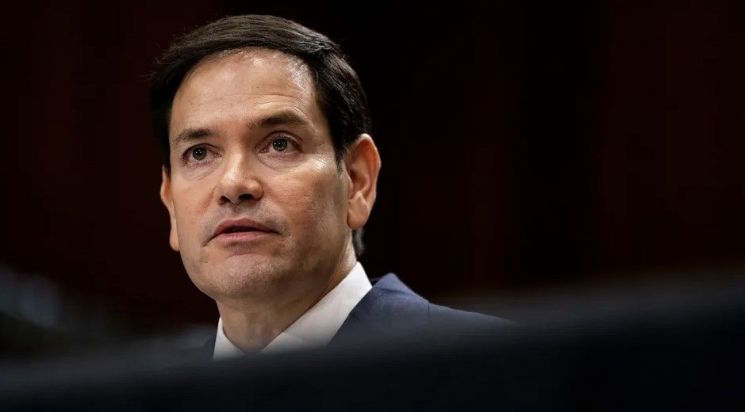
The Wall Street Journal (WSJ) reported on January 6 (local time), citing sources, that Secretary Rubio told congressional leaders in a closed-door briefing the previous day that recent threatening remarks about Greenland do not mean an invasion is imminent. He explained that these remarks are intended to pressure Denmark to come to the negotiating table.
The briefing was originally scheduled to provide an update on the operation to capture Venezuelan President Nicolas Maduro. During the session, Senate Democratic Leader Chuck Schumer asked whether there were plans to use force in Mexico or Greenland, to which Secretary Rubio gave this explanation.
President Trump has maintained that the United States must directly control Greenland, an autonomous territory of Denmark, in order to counter Russian and Chinese advances in the Arctic and to secure access to key minerals buried there.
The previous day, speaking to reporters aboard Air Force One, he asserted, "From a national security perspective, we need Greenland, and the European Union also knows that we should own Greenland."
White House spokesperson Karoline Leavitt recently stated, "Securing Greenland is a national security priority for the United States and is essential to deterring adversaries in the Arctic. The use of military force by the Commander-in-Chief is always one of the possible options."
The Danish government is pushing back. Danish Prime Minister Mette Frederiksen said in a local broadcast interview, "If the United States attacks a NATO member (Denmark) to occupy Greenland, all systems as we know them-international society, democratic rules, and NATO-would collapse."
According to opinion polls, the majority of Greenland residents oppose incorporation into the United States, suggesting that diplomatic tensions are likely to deepen, the WSJ noted. In its editorial, the WSJ added, "The invasion-related remarks are likely Trump-style bluster meant to expedite purchase negotiations or expand America's presence, but even hinting at the use of force is already damaging U.S. interests across the Atlantic."
The editorial continued, "If the U.S. sours relations with allies over Greenland, it could give Russian President Vladimir Putin an opportunity to drive a wedge between the United States and Europe. Ultimately, this would benefit Putin and reduce U.S. leverage in resolving the Ukraine issue."
On the previous day, seven countries-United Kingdom, France, Germany, Italy, Poland, Spain, and Denmark-issued a joint statement expressing support for Greenland and Denmark. The statement declared, "Greenland belongs to the people of Greenland, and only Denmark and Greenland have the authority to decide matters concerning them."
© The Asia Business Daily(www.asiae.co.kr). All rights reserved.
!["The Woman Who Threw Herself into the Water Clutching a Stolen Dior Bag"...A Grotesque Success Story That Shakes the Korean Psyche [Slate]](https://cwcontent.asiae.co.kr/asiaresize/183/2026021902243444107_1771435474.jpg)
















