Woo Wonshik Holds Meeting on Revising National Referendum Act on January 7
"Ten Years After Constitutional Court Ruling, the Law Remains Unamended"
National Assembly Speaker Woo Wonshik has called for the swift revision of the National Referendum Act, which was found to be unconstitutional due to restrictions on overseas Koreans' voting rights. He criticized the delay in amending the law, stating that discussions on constitutional revision are also stalled as a result.
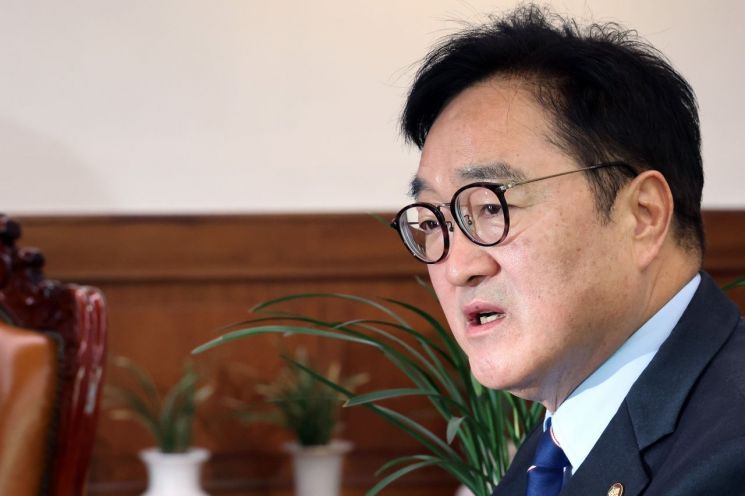
On January 7, at the Speaker's office in the National Assembly in Yeouido, Speaker Woo held a meeting on the revision of the National Referendum Act. He stated, "In July 2014, the Constitutional Court ruled that the provision in the National Referendum Act restricting voting rights for overseas Koreans was unconstitutional and decided that the law should be amended by the end of December that year. However, even after 10 years, the law has not been revised, and the unconstitutionality remains unaddressed. It is a shameful situation." He added, "Leaving this unresolved means the National Assembly is not fulfilling its role."
The meeting was attended by Shin Jeonghun, Chairman of the Public Administration and Security Committee of the National Assembly from the Democratic Party of Korea, Yoon Kunyoung, the committee's secretary, and Jeong Jaehwang, Chairman of the National Future Constitutional Amendment Advisory Committee.
Speaker Woo pointed out that the delay in revising the National Referendum Act is also affecting discussions on constitutional amendment. He explained, "Ahead of the local elections, there is strong support for constitutional revision aimed at balanced national development. However, there are also opinions that, rather than amending the constitution due to the emergency and unconstitutional martial law of December 3, the priority should be to bring an end to the rebellion."
Speaker Woo stated, "Since the trial related to the rebellion is heading toward a first-instance verdict, there is a possibility that, after the ruling, the ruling and opposition parties could begin discussions on constitutional amendment under new circumstances, such as forming a special committee on constitutional revision. However, the public finds it hard to accept that discussions on constitutional amendment cannot even begin because the basic procedure of revising the National Referendum Act has not been completed."
He also emphasized that revising the National Referendum Act is even more important to enable the ruling and opposition parties to pursue a step-by-step constitutional amendment at a level they can agree upon. The constitutional amendments Speaker Woo believes could be agreed upon include: ▲ inclusion of the spirit of the May 18 Democratization Movement in the preamble of the Constitution; ▲ specifying the requirement for National Assembly approval in the conditions for emergency martial law; and ▲ reflecting balanced regional development before the June local elections in the Constitution.
Speaker Woo said, "These are all proposals that could be agreed upon by both the ruling and opposition parties, and especially after the first-instance verdict in the trial of former President Yoon Suk-yeol, the prospects for discussion may change. Therefore, the revision of the National Referendum Act must not be delayed. Resolving the issue of unconstitutionality and focusing on revising the National Referendum Act, which is the minimum requirement for a new Constitution that reflects both the present and future of the Republic of Korea, is essential."
© The Asia Business Daily(www.asiae.co.kr). All rights reserved.

















