Controversy Over 'From Scratch' Standards for Proprietary AI Models
"Adoption of External Encoder Was a Technical Decision...Possible to Replace with In-House Encoder"
Some Argue "Does Not Meet Licensing Requirements"
Ambiguous 'From Scratch' Criteria... "Need to Establish Standards Through Discussion"
Naver Cloud has stated that the vision encoder in its proprietary artificial intelligence (AI) foundation model, developed "from scratch," which has come under scrutiny for allegedly borrowing from a Chinese model, is an area that can be replaced with its own technology. On January 7, a Naver Cloud representative told The Asia Business Daily, "The vision encoder is a kind of tool that is compatible with the foundation model," adding, "It is possible to switch to our own encoder in the future as the model is further developed."
According to the IT industry, the controversy began when claims emerged that the vision encoder weights (parameters) in Naver Cloud's "HyperCLOVA X SEED 32B Think" model and those in China's Alibaba open-source AI model "Qwen 2.4" showed high cosine similarity and Pearson correlation coefficients. Cosine similarity measures the directionality of models, while the Pearson correlation coefficient indicates the correlation between models. The higher these indicators, the greater the similarity between the models.
The debate arose over the "from scratch" requirement for proprietary AI projects. The government’s proprietary AI foundation model project introduced "from scratch" development as an evaluation standard to avoid reliance on foreign technology, but there have been criticisms that this standard was not clearly defined.
Naver Cloud: "Considering Replacement with In-House Encoder in the Future"
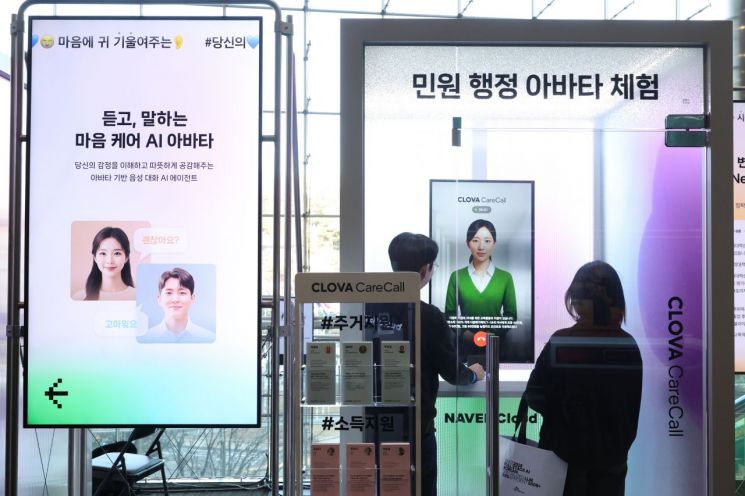 On the 30th of last month, attendees are experiencing the Naver Cloud booth at the first presentation of the 'Independent AI Foundation Model' project held at COEX in Gangnam-gu, Seoul. Photo by Yonhap News
Naver Cloud was the only one among the five participating consortiums in this project to unveil an omni-modal model capable of processing visual (image, video) and audio data. In doing so, it explained that it utilized the vision encoder from Alibaba’s model. The vision encoder converts visual information from images or videos into signals that the AI model can understand.
Naver Cloud maintains that the use of Alibaba’s model was not due to a lack of technological capability. The company explained, "It was a technical decision to enhance the overall completeness and stability of the model by using already standardized high-performance modules, not because of insufficient technological independence," adding, "We already possess sufficient proprietary vision technology, such as VUClip." According to Naver Cloud, if the foundation model serves as the "brain" responsible for human thought and identity, the vision encoder functions as the "optic nerve" that converts visual information into signals the model can interpret.
However, some argue that, given the significant role of the vision encoder in an omni-modal model, external models should not have been used. The vision encoder not only converts visual information into a form the AI can understand but also assigns weights to key visual information, making its importance nearly as great as that of the main model. In this sense, the vision encoder partially performs the role of the brain, not just the optic nerve.
The vision encoder also accounts for a significant portion of the model’s operation. According to industry sources, in the operation of HyperCLOVA X SEED 32B, the vision encoder constitutes about 12% of the parameters.
Controversy Over 'Proprietary' Foundation Model Ignites..."Need for 'From Scratch' Standard"
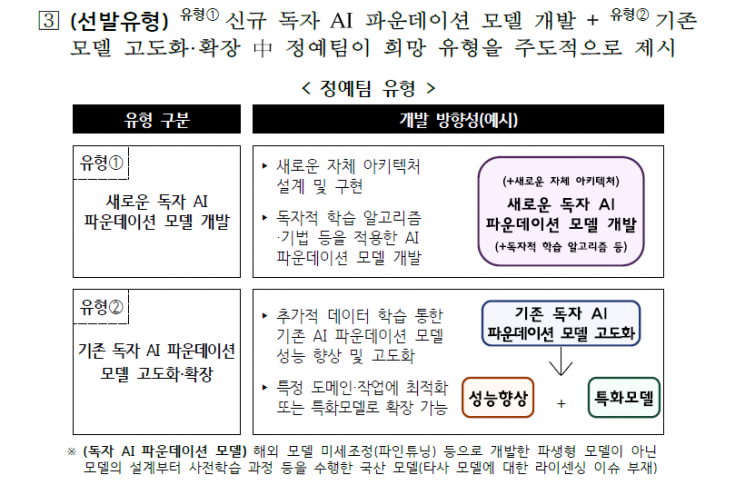
Some have also pointed out that, due to licensing issues, HyperCLOVA X SEED 32B does not meet the "from scratch" standard. According to the standards presented at the time of the proprietary AI foundation model project call for proposals, "the model must be domestically developed from design to pre-training, with no licensing issues related to third-party models."
Based on this standard, if Alibaba changes the licensing of the open-source Qwen 2.4, HyperCLOVA X SEED 32B would not meet the "from scratch" criteria. Open source means that the software is made available for anyone to use during the development process.
Choi Byungho, Director of the Korea University AI Research Institute, stated, "If we go strictly by the call for proposals, HyperCLOVA X SEED 32B is unlikely to qualify as a proprietary AI foundation model," adding, "It's not a matter of lacking technological capability, but rather a strategic issue of not submitting the model in a form that fits the project requirements."
Some argue that since the "from scratch" standard is ambiguous, this controversy should prompt the AI industry and academia to establish clear criteria. One official from the domestic AI industry commented, "Since domestic AI foundation model development is still in its early stages, the ambiguity of the 'from scratch' standard has led to such controversies," adding, "It would be meaningful to establish standards through discussions between academia and industry."
The Ministry of Science and ICT, which oversees this project, also stated that it has not set specific criteria for "from scratch." A ministry official said, "Where an AI model begins is an abstract concept with varying opinions," adding, "There is no global standard for 'from scratch,' and discussions are ongoing within the industry." The ministry believes that the standard for "from scratch" should be established through discussions among experts and industry stakeholders.
However, it appears that this controversy will affect the first evaluation of proprietary AI, which is scheduled for mid-January. The official explained, "A multidimensional evaluation will be conducted in the first round, and this controversy will be considered in the evaluation," but also noted, "It cannot be definitively stated that it will determine the outcome." The ministry will eliminate one of the five elite teams through this month's evaluation.
Meanwhile, allegations of model plagiarism continue to surface among participants in the proprietary AI foundation model project. Previously, Upstage's "Solar Open 100B" also faced suspicions of replicating a Chinese AI model. However, during a public verification process led by Upstage CEO Kim Sunghoon, it was revealed that there were errors in the statistical interpretation, and the party that raised the allegations issued an apology, bringing the matter to a close for now.
© The Asia Business Daily(www.asiae.co.kr). All rights reserved.


















