Lim Hojun's Team at Asan Medical Center Achieves 94% Treatment Success Rate Using Family Donors
A new path to a cure has opened for pediatric and adolescent patients with aplastic anemia who have struggled to find a fully matched donor for treatment. Now, they can achieve a cure through haploidentical hematopoietic stem cell transplantation from a parent or sibling.
 Professor Lim Hojun of the Department of Pediatric Hematology-Oncology at Asan Medical Center is treating a patient with aplastic anemia who received a haploidentical hematopoietic stem cell transplantation from a family donor. Asan Medical Center.
The hematopoietic stem cell transplantation team at the Department of Pediatric Hematology-Oncology at Asan Medical Center-Professors Lim Hojun, Ko Kyungnam, Kim Hyeri, Kang Seonghan, and Specialist Nurse Choi Eunseok-announced on January 7 that the treatment success rate reached 94% when pediatric and adolescent patients with aplastic anemia received haploidentical hematopoietic stem cell transplantation from a family member whose tissue compatibility was only half-matched.
This study is considered a significant achievement that has demonstrated, on a global scale, that haploidentical hematopoietic stem cell transplantation can be used as a first-line treatment for pediatric and adolescent patients with aplastic anemia who lack an appropriate donor.
Aplastic anemia is a disease caused by the decreased function of bone marrow, resulting in a deficiency of white blood cells, red blood cells, and platelets, which can lead to severe infections, anemia, and bleeding. Without treatment, normal daily life is impossible and the disease can be life-threatening. The only curative method is to restore the damaged bone marrow function to a healthy state through hematopoietic stem cell transplantation.
However, in Korea, the likelihood that a pediatric or adolescent patient in need of hematopoietic stem cell transplantation will find a sibling donor with a fully matched tissue type is only about 1 in 10. Even when including unrelated donors, the research team explained that 40-50% of all pediatric and adolescent patients still cannot find a suitable donor.
If an appropriate donor cannot be found, immunosuppressive therapy can be used as a first-line treatment. However, the success rate is not high, and in many cases, the effects do not last. If the patient does not respond to immunosuppressive therapy, they must receive regular transfusions of red blood cells or platelets, use prophylactic antibiotics, and, if an infection occurs, receive immediate antibiotic treatment as part of their daily life.
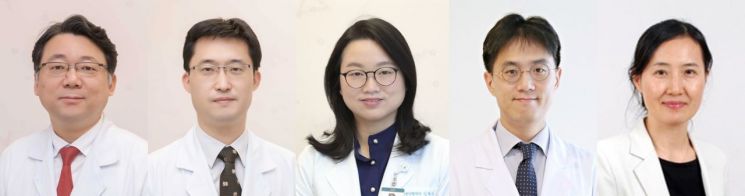 From the left, Professor Hojoon Lim, Professor Kyungnam Ko, Professor Hyeri Kim, Professor Seonghan Kang of the Department of Pediatric Hematology-Oncology at Asan Medical Center, and Specialist Nurse Eunseok Choi. Asan Medical Center.
The hematopoietic stem cell transplantation team at Asan Medical Center has focused on treatment using haploidentical hematopoietic stem cell transplantation from donors whose tissue compatibility is only half-matched, such as parents, siblings, or children. It is relatively easier to secure a haploidentical family donor, such as a parent, sibling, or child, and in cases where there is no suitable matched donor and the patient does not improve with immunosuppressive therapy, a haploidentical family donor is considered a practical alternative.
However, haploidentical hematopoietic stem cell transplantation also requires caution as a first-line treatment, since severe chronic graft-versus-host disease may develop after transplantation, causing significant disruption to the daily lives of pediatric and adolescent patients and, in some cases, posing a life-threatening risk. Clinical studies using haploidentical hematopoietic stem cell transplantation as a first-line treatment for pediatric and adolescent patients with aplastic anemia are rare worldwide, making robust clinical evidence necessary.
The research team analyzed the outcomes of 37 pediatric and adolescent patients with aplastic anemia who underwent haploidentical hematopoietic stem cell transplantation as a first-line treatment at Asan Medical Center from December 2015 to July 2024. As a result, 35 of the treated patients were completely cured and are now living normal daily lives. Notably, not a single case of severe chronic graft-versus-host disease was observed. In addition, neutrophil engraftment occurred rapidly, on average within 10 days after transplantation, and the overall treatment success rate reached 94%.
Professor Lim Hojun stated, "This study is highly meaningful as it provides important evidence that haploidentical hematopoietic stem cell transplantation can be established as a first-line treatment. We hope that further technological advancements will open the path to a cure for pediatric and adolescent patients with aplastic anemia."
The results of this study were recently published in the internationally renowned journal in the field of hematopoietic stem cell transplantation, 'Transplantation and Cellular Therapy' (Impact Factor 4.4), the official journal of the American Society for Transplantation and Cellular Therapy.
© The Asia Business Daily(www.asiae.co.kr). All rights reserved.
![Clutching a Stolen Dior Bag, Saying "I Hate Being Poor but Real"... The Grotesque Con of a "Human Knockoff" [Slate]](https://cwcontent.asiae.co.kr/asiaresize/183/2026021902243444107_1771435474.jpg)

















