A Variety of Cultural Terms Added Amid Korean Wave Expansion
Oxford Says "Reflecting Frequency and Influence"
Eight words originating from Korean culture have been newly added to the Oxford English Dictionary (OED), the world’s most authoritative English dictionary published by the University of Oxford. The newly listed words include "ramyeon," "jjimjilbang," "sunbae," "bingsu," "ajumma," "haenyeo," "Korean barbecue," and "officetel."
 The Japanese food 'ramen' and the Japanese female divers 'ama' were already listed in the Oxford English Dictionary (OED), but the Korean pronunciations and cultural contexts of 'ramyeon' and 'haenyeo' have only recently been recognized as separate entries. Pixabay
On January 7, Ji-Eun Care (Korean name: Cho Ji-eun), the Korean language consultant for the Oxford English Dictionary and a professor at the Faculty of Asian and Middle Eastern Studies at the University of Oxford, told Yonhap News, "With the recent spread of the Korean Wave, words that are now frequently used in the English-speaking world have been included in the dictionary." The addition of Korean words to the OED marks the second consecutive year, following the inclusion of seven words such as "dalgona," "maknae," and "tteokbokki" last year.
In 2021, the simultaneous addition of 26 words, including "daebak" and "oppa," drew significant attention. Among the newly included words, "ramyeon" and "haenyeo" are prime examples of terms whose usage in English has surged alongside the global popularity of Korean content. While the Japanese food "ramen" and the Japanese female divers "ama" were already listed in the OED, the Korean pronunciations and cultural contexts of "ramyeon" and "haenyeo" have only recently been recognized as separate entries.
Professor Care explained, "In the case of 'haenyeo,' we attempted to have it listed a few years ago, but at that time, there was a lack of English-language materials and research." She added, "With the recent increase in English-language references thanks to dramas and documentaries featuring haenyeo, its inclusion became possible." Similarly, "jjimjilbang" and "bingsu" were naturally adopted by foreign media and social networking services due to the popularity of K-dramas and K-food, leading to their addition to the dictionary.
'Sunbae' Draws Attention as a Concept Absent in English-Speaking Cultures
Particularly noteworthy is the word "sunbae." Unlike the English term "senior," it encompasses age, experience, and hierarchy, reflecting a uniquely Korean relational concept with no exact equivalent in English-speaking cultures. For this reason, Korean honorifics such as "nuna," "hyung," and "maknae" have been steadily added to the OED.
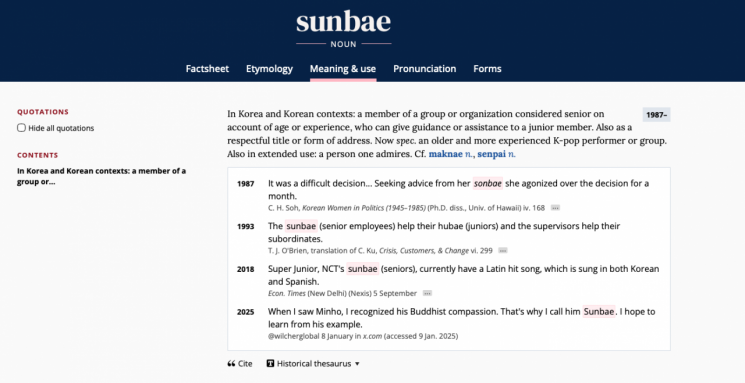 The word to focus on this time is "sunbae." Unlike the English term "senior," it encompasses age, experience, and hierarchy, reflecting a uniquely Korean relational concept with no exact equivalent in English-speaking cultures. Oxford Dictionary
In the food category, "galbi," "samgyeopsal," and "bulgogi" had already been included, and this time, "Korean barbecue" was added for the first time as an English expression. The OED cited an early usage example from a 1938 issue of the Honolulu Star-Bulletin, which stated, "A Korean barbecue dinner was served."
First published in 1884, the Oxford English Dictionary is now operated online and contains about 500,000 words and phrases, with definitions, etymologies, and real usage examples. Actual usage in novels, academic papers, news articles, and social media posts serves as the standard for inclusion. Professor Care emphasized, "Once a word is added to the Oxford English Dictionary, it is never deleted, even if it falls out of use over time. The fact that words from Korean culture leave a mark in the global language of English carries great historical significance."
© The Asia Business Daily(www.asiae.co.kr). All rights reserved.


















