KCCI Conducts Comprehensive Review of 12 Laws Proposed in the 22nd National Assembly
94 Cases of Increased Regulation and 55 Cases of Reduced Benefits as Companies Grow
65 Out of 94 "Regulation Increase" Bills Target the Commercial Act
"Benefit Reduction" Bills Concentrated in the Restriction of Special Taxation Act
Urgent Need to Shift the Institutional Paradigm to Incentivize Growth
Since the launch of the 22nd National Assembly, a large number of bills introducing "differentiated regulations by company size," which increase burdens as companies grow, have been proposed. This has led to criticism that such regulations are hindering corporate growth.
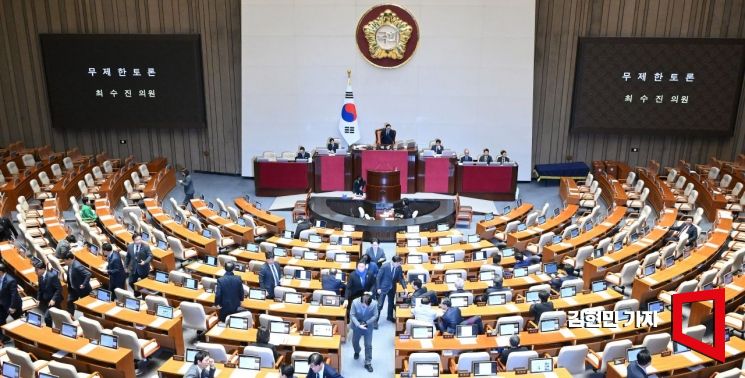
According to the business community on January 7, the Korea Chamber of Commerce and Industry (KCCI) announced the results of a comprehensive review of 1,021 bills proposed from the launch of the 22nd National Assembly (May 30, 2024) through December 31, 2025, based on 12 laws closely related to business activities. The review found that a total of 149 bills included provisions for differentiated regulations based on company size.
This review was based on 12 laws, including the Commercial Act, the Capital Markets Act, the Act on External Audit of Stock Companies, the Monopoly Regulation and Fair Trade Act, the Medium-Standing Enterprises Act, the Financial Holding Companies Act, the Financial Conglomerates Act, the Distribution Industry Development Act, the Win-Win Cooperation Act, the Serious Accidents Punishment Act, the Industrial Safety and Health Act, and the Restriction of Special Taxation Act. Differentiated regulations proposed in the National Assembly were classified into two types: "regulation increase," where larger companies face more regulations, and "benefit reduction," where larger companies receive fewer benefits.
The KCCI emphasized that differentiated regulations by company size represent a unique "growth penalty" that exists only in Korea. "These regulations weaken the incentive for companies to grow by scaling up, thereby entrenching an ecosystem that discourages growth throughout the economy," the KCCI stated. "It is necessary to thoroughly reconsider the legislative practice of repeatedly expanding ambiguous size criteria and to redesign the regulatory paradigm from scratch."
There were 94 "regulation increase" differentiated regulation bills proposed in the 22nd National Assembly. Among the laws, the Commercial Act accounted for the most with 65 bills, followed by the Distribution Industry Development Act (12 bills), the Industrial Safety and Health Act (7 bills), and the Monopoly Regulation and Fair Trade Act (6 bills). In particular, the Commercial Act, which has been the focus of amendment discussions under the current administration, saw a concentration of bills imposing additional governance and decision-making obligations-such as the introduction of electronic general meetings of shareholders and expanded separate appointments of audit committee members-exclusively on companies with assets of 2 trillion won or more.
The KCCI argued that the "2 trillion won in assets" criterion, which was introduced in 2000, continues to be used as a matter of practice without separate verification, despite significant changes in the size of the economy and price levels, and that a rational review of this standard is necessary. The KCCI also pointed out that the Distribution Industry Development Act still imposes mandatory closures only on large stores, based on outdated consumer behavior patterns. With the rapid shift in consumption patterns toward online and mobile channels, the KCCI argued that regulations targeting only offline retailers of a certain size should be reconsidered in terms of effectiveness and fairness.
There were 55 "benefit reduction" differentiated regulation bills proposed in the 22nd National Assembly, which reduce tax benefits as company size increases.
All of the benefit reduction differentiated regulation bills were concentrated in the Restriction of Special Taxation Act. These bills mainly provided tax credits for research and development (R&D), facility investment, and the development of specific technologies, but applied different deduction rates depending on company size or limited the benefits to only small and medium-sized enterprises and medium-standing enterprises. The KCCI pointed out that benefit reduction differentiated regulations have limitations in terms of efficiency and strategy. As global competition intensifies, large companies must directly compete with overseas firms through large-scale investments, but tax benefits are only applied in a limited manner.
Kang Seokgu, Director of the KCCI Research Division, stated, "In an environment of intensifying global technological competition, dividing regulations and benefits based on company size is no longer an effective policy tool. It is essential to thoroughly re-examine the accumulated differentiated regulations by size and to redesign the institutional paradigm to promote growth and innovation."
© The Asia Business Daily(www.asiae.co.kr). All rights reserved.

















