In a crackdown on multinational cigarette smuggling rings using South Korea as a transshipment hub, authorities seized and confiscated 5.16 million packs of cigarettes (103 tons). This marks the largest seizure ever, highlighting the increasing frequency of attempts to use South Korea as a transit point for smuggling cigarettes to third countries.
The Korea Customs Service announced on January 7 that, based on its own intelligence analysis and international cooperation, it provided information on 50 suspected smuggling shipments to customs authorities overseas last year-including 23 cases in Australia, 8 in Hong Kong, and 5 in Taiwan-leading to the detection and seizure of large volumes of smuggled cigarettes.
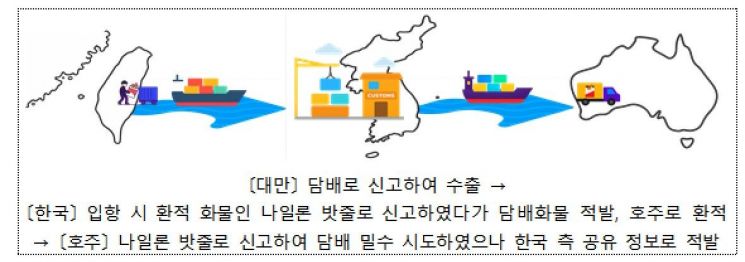
This outcome is the result of monitoring the movement and transshipment information of suspected smuggling shipments, based on risk data derived from the agency’s own analysis of import and export cargo information, as well as intelligence obtained through key partner countries such as the United Kingdom, China, and Taiwan.
The smuggled cigarettes were exported illegally via South Korea and detected in countries such as Australia, the United States, and France. The seized 5.16 million packs are enough to provide more than half of all adult smokers in South Korea (estimated at 8 to 9 million people) with one pack each. This figure exceeds the 3.6 million packs detected overseas between 2019 and 2021, as previously disclosed by the Korea Customs Service in 2021. This demonstrates that cases of smuggled cigarettes being traded through South Korea as a transshipment hub are becoming increasingly common.
In particular, Australia detected a total of over 3.17 million packs of smuggled cigarettes using information provided by the Korea Customs Service. Considering that each pack of cigarettes in Australia is subject to a consumption tax of around 30,000 won, this is estimated to have prevented tax evasion worth approximately 95 billion won in advance.
It has been reported that information provided by the Korea Customs Service played a decisive role in the detection of smuggled cigarettes by customs authorities in Australia and other countries.
The seriousness of cigarette smuggling is also significant within South Korea, as attempts to use the country as a transshipment hub for smuggled goods continue unabated. In fact, in March of last year, smuggled cigarettes detected by Australian customs had originated in Taiwan, passed through South Korea disguised as returned cargo, and were then re-exported to Australia.
However, the Korea Customs Service was able to identify, through analysis and customs inspection of the returned cargo, that the items being shipped did not match the declared description (nylon rope) and were actually cigarettes. By providing this information to Australian customs, the smuggled cigarettes were detected locally in Australia.
The problem is that smuggled cigarettes are highly likely to serve as a major funding source for international organized crime, alongside drugs. The Korea Customs Service believes that transnational cigarette smuggling is not limited to simple smuggling crimes but that the proceeds are likely to be used for serious international crimes, such as drug trafficking and arms trading.
Most notably, the method of disguising cigarettes as legitimate cargo in high-risk countries, exporting them, and then transshipping them through South Korea to third countries allows smugglers to evade customs surveillance. The Korea Customs Service explains that, without international cooperation, it is difficult to effectively crack down on such activities.
A Korea Customs Service official stated, "Exchanging risk information between countries is essential to effectively block the movement of illegal goods using transshipment cargo," adding, "To support this, we will systematize information-sharing standards and further advance our methods of cooperation."
The official also said, "We will strengthen cooperation with existing partner countries such as Australia, the United States, France, and Hong Kong, while expanding the scope of collaboration to Southeast Asia and Central and South America, in order to establish a robust international cooperation system to block multinational organized crime."
© The Asia Business Daily(www.asiae.co.kr). All rights reserved.

















