Samsung Display Develops 'Smart Power HDR'
"An Important Advancement in Performance and Power Optimization"
Samsung Display and Intel have jointly developed next-generation technology that can reduce OLED power consumption by up to 22% in high dynamic range (HDR) mode on laptops. With the widespread adoption of artificial intelligence (AI) PCs, this advancement is expected to improve not only battery efficiency but also the overall HDR high-quality user experience.
On January 7, Samsung Display announced that it has partnered with Intel to jointly develop the next-generation low-power technology called 'Smart Power HDR™.' This is a low-power technology that allows users to enjoy HDR mode on laptops with relatively low power consumption. Typically, display power consumption is heavily influenced by the driving voltage. In conventional HDR mode, the driving voltage is fixed at a high level regardless of the content, resulting in unnecessary power loss. In contrast, 'Smart Power HDR' adjusts the voltage according to the content, enabling power savings.
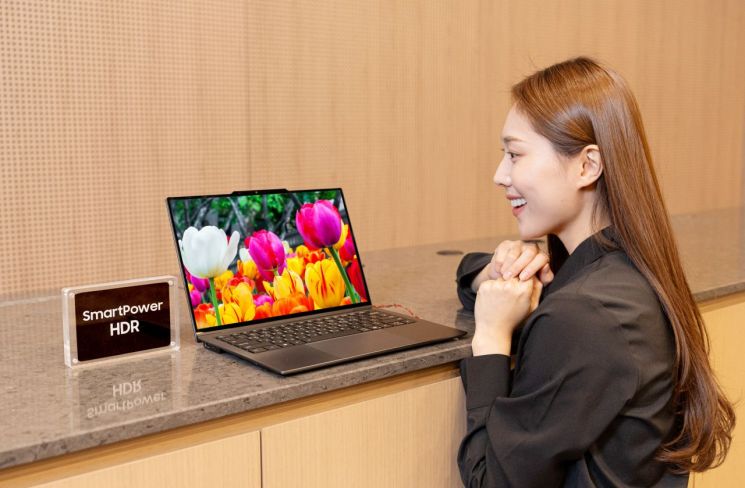 Samsung Display announced on the 7th that it has partnered with Intel to jointly develop the next-generation low-power technology called "Smart Power HDR™." This is a low-power technology that allows users to enjoy HDR mode on laptops with relatively low power consumption. Samsung Display
For general laptop usage environments such as web browsing or document editing, the display can be operated at a lower voltage. However, when running high-quality games or videos, higher luminance is required, which demands higher voltage. Conventional HDR mode maintains maximum luminance and high voltage regardless of the content, leading to unnecessary power consumption during typical use. Samsung Display explained that despite the advantages of HDR mode-which delivers clearer and more vivid content for videos and games-many laptop products still offer standard dynamic range (SDR) as the default image quality mode due to its limited color gamut and brightness.
However, 'Smart Power HDR' can reduce OLED luminous power consumption by up to 22% in general usage environments such as web browsing, and by up to 17% in high-quality playback environments compared to conventional HDR mode. In particular, for general usage scenarios like document editing, power consumption is similar to that of SDR mode.
Samsung Display has continued its collaboration with Intel for technology development since signing a memorandum of understanding in February last year. The two companies explained that 'Smart Power HDR' is implemented by analyzing the maximum luminance value for each frame in real time on the laptop's system-on-chip (SoC), transmitting this data to the OLED panel's timing controller (T-CON), and then having the T-CON analyze both the luminance data and the on-pixel ratio (OPR) to adjust the driving voltage appropriately for the content.
Jung Yongwook, Vice President and Head of IT Strategic Marketing at Samsung Display, stated, "Smart Power HDR is a complete HDR solution that allows consumers to truly experience the excellence of HDR beyond just specifications. We will continue to advance Smart Power HDR technology and develop various OLED low-power technologies so that consumers can enjoy vivid HDR high-quality content on their laptops."
Todd Lewellen, General Manager of Intel's PC Ecosystem and AI Solutions, commented, "Since displays account for more than half of a laptop's total power consumption, improving efficiency is a key goal. This collaboration represents a significant breakthrough, pushing the boundaries of visual innovation and marking an important advancement in both performance and power optimization."
© The Asia Business Daily(www.asiae.co.kr). All rights reserved.
![User Who Sold Erroneously Deposited Bitcoins to Repay Debt and Fund Entertainment... What Did the Supreme Court Decide in 2021? [Legal Issue Check]](https://cwcontent.asiae.co.kr/asiaresize/183/2026020910431234020_1770601391.png)
















