Linking National Policies in Railways, Rivers, Power Grids, Tourism, and Agriculture
Cooperation with Central Ministries to Secure Funding for Strategic Projects
Building the Foundation for Naju’s Future Growth through Systematic Administrative Response
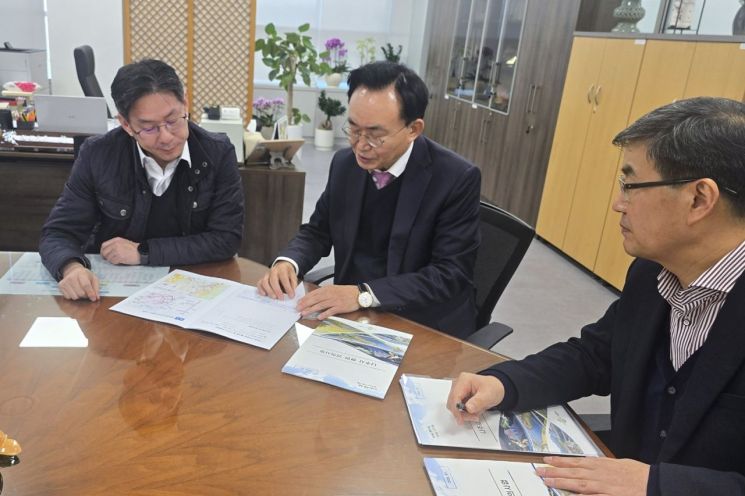 Yoon Byungtae, Mayor of Naju City (center in the photo), visited central government ministries including the Ministry of Planning and Budget on the 5th to proactively propose key pending projects for inclusion in the 2027 national budget. Provided by Naju City
Naju City in South Jeolla Province is already laying the groundwork for 2027. In order to align the region’s core mid- to long-term agenda items with national policies, the city has proactively visited central government ministries to propose the inclusion of these projects in the 2027 national budget, thereby establishing a stable foundation for securing government funding.
On January 5, Naju City announced that it had visited central ministries such as the Ministry of Planning and Budget, the Ministry of Land, Infrastructure and Transport, the Ministry of Trade, Industry and Energy, the Ministry of Climate, Energy and Environment, the Ministry of Culture, Sports and Tourism, and the Ministry of Agriculture, Food and Rural Affairs to propose key pending projects that require inclusion in the 2027 national budget.
This visit aimed to directly link Naju’s core projects-such as those related to railways, rivers, power grids, tourism, and agricultural infrastructure-with national policies, thereby increasing the likelihood of securing government funding. Discussions focused on the necessity and feasibility of each project.
In particular, with the recent government reorganization separating the Ministry of Economy and Finance into the Ministry of Finance and Economy and the Ministry of Planning and Budget, the importance of consultation with the Ministry of Planning and Budget, which is responsible for budget formulation and mid- to long-term fiscal strategies, has grown. Mayor Yoon Byungtae and his team met with officials including Budget Office Director Cho Yongbeom to specifically explain the need for national funding for Naju’s major projects and to request their cooperation.
Naju City secured 540.3 billion won in the 2026 national budget, the largest amount since the city’s establishment. In addition, the city has been steadily building a foundation for regional growth in connection with central government policies, as national energy projects have been successively reflected, including the confirmation of the site for the artificial sun (nuclear fusion) research facility (total project cost: 1.2 trillion won) and the approval for the construction of the National Energy Science Museum (total project cost: 46 billion won).
Based on these achievements, Mayor Yoon visited the central ministries to explain the continuity and expansion potential of previously secured national projects and actively requested cooperation on major pending projects that require future government funding.
First, the Gyeongjeon Line (Gwangju Songjeong~Suncheon) Naju section triangle line construction project (total project cost: 70 billion won) is a railway infrastructure project directly connecting Naju Station (KTX) and the Gyeongjeon Line. Its main objectives are to improve the connectivity of the eastern and western Jeollanam-do railway networks and to enhance access to Muan International Airport.
Naju City emphasized that early implementation would deliver significant fiscal efficiency and network effects for the railway system, and requested a national-level review.
Additionally, the Yeongsan River river environment improvement project (total project cost: 3.2 billion won) aims to prevent disasters and ensure resident safety by reconstructing aging bridges and reinforcing and expanding embankments. The city explained the need to include the design costs for 2026 in the budget.
In the energy sector, the city proposed designating a specialized complex for advanced power grid equipment materials, parts, and devices, as well as establishing a new 70kV-class transmission line testing and certification center (total project cost: 200 billion won).
These initiatives are expected to have a ripple effect as national strategic projects supporting the localization of power equipment, leveraging Naju’s strengths as a hub of energy research and demonstration infrastructure, including Korea Electric Power Corporation and Korea Institute of Energy Technology (KENTECH).
Furthermore, the city presented plans for the second phase of the Southern Region Wide-Area Tourism Development Project (total project cost: 135 billion won), centered around the Yeongsan River Garden. This includes constructing a pedestrian bridge connecting Naju Station and the Yeongsan River Garden and expanding experiential tourism facilities to establish a foundation for stay-type tourism.
In addition, to address the structural problems of farmland that repeatedly suffers from flooding, the city proposed designating the Naju Sanho District Drainage Improvement Project (total project cost: 11.9 billion won) as a new project site for 2026.
Naju City plans to continue systematic administrative efforts and ongoing consultations with the central government to ensure that major pending projects are reflected in national policies and budgets.
Mayor Yoon Byungtae stated, "Based on the national projects and public contest achievements we have secured so far, we are organically connecting Naju’s agenda items with national policy. We will do our utmost to work closely with central ministries to ensure that the projects needed for regional development are stably promoted."
© The Asia Business Daily(www.asiae.co.kr). All rights reserved.

















