Wonoh Jeong Criticizes, "It Was Oh Who First Canceled New Towns"
Oh Sehoon’s Side Responds, "It Was the Democratic Party That Dried Up the Seeds of Housing Supply"
Byungmin Kim, Deputy Mayor for Political Affairs of Seoul, responded to Seongdong-gu Mayor Wonoh Jeong, who criticized Mayor Sehoon Oh for Seoul’s housing supply shortage, by saying, "Do not distort the essence, and first repent for the original sin of the Democratic Party, which dried up the seeds of housing supply."
On this day, Deputy Mayor Kim stated on his social networking service (SNS), "Mayor Wonoh Jeong of Seongdong-gu attributed the cause of Seoul’s housing supply shortage to some adjustments made to the New Town project during Mayor Sehoon Oh’s first term," adding, "He then argued with the bizarre logic that the cancellation of redevelopment projects by the previous mayor was simply an extension of Mayor Oh’s policies."
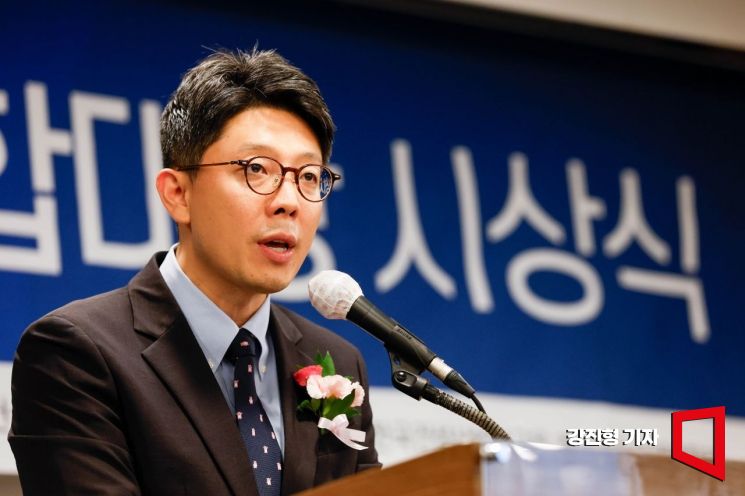 Byungmin Kim, Deputy Mayor for Political Affairs of Seoul, is delivering a congratulatory speech at the 20th Asia Construction Awards held at the Press Center in Jung-gu, Seoul on September 24, 2025. Photo by Jinhyung Kang
Previously, Mayor Jeong had targeted Mayor Oh on his own SNS, stating, "It was Mayor Oh who first canceled the New Town designations," and, "Just four months later, he resigned due to the free school meal residents’ referendum. Had he not resigned, he might have canceled even more New Town designated areas."
In response, Deputy Mayor Kim explained, "At the time, Mayor Oh sought solutions only for certain areas among the planned redevelopment zones where projects had not progressed for a long time, causing ongoing resident conflicts and infringement of property rights due to restrictions on construction activities," and, "These areas had been designated as redevelopment zones despite the lack of project feasibility, which led to rising real estate prices and a worsening business outlook." He pointed out that these zones amounted to only 31 out of the 315 total planned redevelopment zones at the time, just 9.8%.
He further emphasized, "What is clear is that even at the time of the 2011 announcement, the city of Seoul firmly maintained its basic policy stance on promoting the New Town project," and, "The policy clearly stated that the city would stabilize the New Town project by introducing a public management system and strengthening administrative and financial support."
Additionally, he said, "The true beginning of indiscriminate New Town cancellations started with the establishment of the 'Diagnosis and Remedial Measures for the New Town Redevelopment Problem' during former Mayor Park Wonsoon’s term in 2012," and, "From that point, the city of Seoul began explicitly addressing 'cancellation of redevelopment zones' rather than 'planned redevelopment zones,' thus officially launching the policy of New Town cancellations."
He criticized, "The 'new housing policy direction' of 'no more New Town designations going forward' is clearly confirmed in official Seoul city documents during former Mayor Park’s tenure," and, "As a result of this policy stance, 389 redevelopment zones were canceled in bulk from 2012 to 2020, and there were no subsequent efforts to re-designate redevelopment projects or increase supply."
Deputy Mayor Kim stated, "Not only was it problematic to indiscriminately cancel redevelopment projects without standards or principles during the previous mayor’s term, but also, under the pretext of 'preservation,' pouring massive budgets into urban regeneration projects while neglecting the aging city center dried up the seeds of housing and led to a supply disaster," and, "Nevertheless, Mayor Jeong is now distorting facts about the improvement of a very small portion of the New Town project in an attempt to cover up a decade of failed housing policy under the previous mayor, as criticism of the Democratic Party over the housing market turmoil intensifies."
He continued, "This is bad politics, ignoring the uncomfortable facts and selectively distorting only what suits one’s taste," and, "If you truly do not know the fundamental causes of today’s housing supply shortage, it raises serious questions about your policy competence."
He concluded, "Solving Seoul’s housing problem must start not by blaming others, but by squarely facing past mistakes," and, "Politicians from the Democratic Party and those planning to run for Seoul mayor should accurately recognize the facts and begin by reflecting on the wrong policies of the past."
© The Asia Business Daily(www.asiae.co.kr). All rights reserved.

















