On the Occasion of the Korea-China Summit
First Korea-China Environmental and Climate Cooperation Revision in 12 Years
Bilateral Meeting with the National Forestry and Grassland Administration
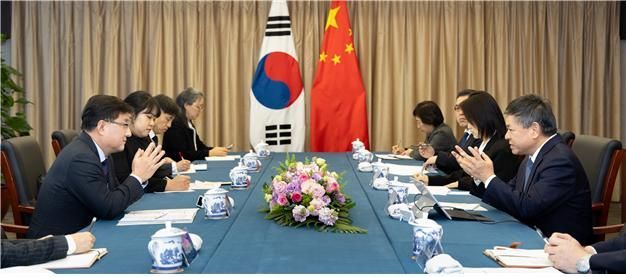 On January 6, 2026, Kim Seonghwan, Minister of Climate Energy and Environment, and Huang Runqiu, Minister of Ecology and Environment of China, held the 7th Korea-China Ministerial Meeting in Beijing, China. Ministry of Climate Energy and Environment
The governments of South Korea and China have agreed to expand the scope of their environmental cooperation from fine dust to include climate change and the circular economy. They have also agreed to deepen their existing cooperation on pandas.
The Ministry of Climate Energy and Environment announced on January 5 that Minister Kim Seonghwan and Huang Runqiu, Minister of Ecology and Environment of China, discussed the implementation of the revised "Memorandum of Understanding on Korea-China Environmental and Climate Cooperation" and strengthened bilateral cooperation on environment and climate at the 7th Korea-China Environment Ministers' Meeting held in Beijing, China.
On the afternoon of the same day, the environment ministers of both countries signed the revised "Memorandum of Understanding on Korea-China Environmental and Climate Cooperation" in the presence of both nations' leaders.
This revision is the first in 12 years since the last amendment in 2014. While the previous revision was prompted by Chinese President Xi Jinping's visit to South Korea, this time, the scope and framework of cooperation have been reorganized on the occasion of President Lee Jaemyung's visit to China.
Through this revision, the two countries have expanded their cooperation, which had previously focused on air issues such as fine dust and yellow dust, to cover a broader range of environmental topics including climate change, the circular economy, and nature conservation. Accordingly, in addition to the existing "Clear Sky Plan" for air quality cooperation, they will gradually establish cooperation plans for each sector in the environment and climate fields.
The two countries have specified the annual convening of the Korea-China Environment Ministers' Meeting, the highest consultative body for environment and climate, and have also defined the roles of director-general level policy dialogues and the Korea-China Environmental Cooperation Center.
Moving beyond cooperation focused solely on air pollution, they have agreed to expand the scope to include joint research on substances that impact both air pollution and climate change.
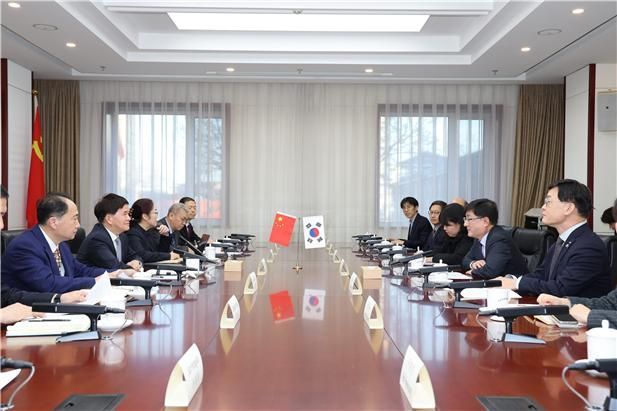 On January 6, 2016, Kim Sunghwan, Minister of Climate, Energy and Environment, held a bilateral meeting with Liu Guohong, Director of the National Forestry and Grassland Administration (National Park Administration) of China, at the National Forestry and Grassland Administration building in Beijing, China. Ministry of Climate, Energy and Environment
Meanwhile, on the morning of January 6, Minister Kim Seonghwan held a bilateral meeting with Liu Guohong, Director of the National Forestry and Grassland Administration (National Park Administration) of China, at the National Forestry and Grassland Administration building in Beijing. They agreed to pursue the establishment of sister park relationships between the Yellow River Delta Nature Reserve in China and national parks in South Korea, in accordance with the "Memorandum of Understanding on National Park Management Cooperation" signed the previous day.
Through this, the two countries will continue to cooperate for the sustainable use of protected areas, including ecological tourism utilizing national parks.
It is also noteworthy that both countries have reviewed the achievements of their panda cooperation and agreed to deepen this cooperation in the future.
Korea-China panda cooperation began with the mention of "support for joint panda research" in the appendix of the joint statement from the Korea-China summit held during President Xi Jinping's visit to South Korea in July 2014. Practical discussions on panda introduction began in September of that year.
In October 2015, during Premier Li Keqiang's visit to South Korea, a memorandum of understanding on pandas was signed between the Ministry of Environment and the National Forestry and Grassland Administration of China. As a result, a pair of pandas (Ai Bao and Le Bao) were introduced in March 2016.
Fu Bao was born to Ai Bao and Le Bao in July 2020, and twins (Rui Bao and Hui Bao) were born in July 2023. Fu Bao was repatriated to China in April 2024.
© The Asia Business Daily(www.asiae.co.kr). All rights reserved.


















