Results of the Korea-China Summit
Summit Lasted 90 Minutes, Exceeding Expectations by 30 Minutes
Emphasis on Cooperative Partnership Between the Two Countries
Amicable Atmosphere Throughout
Signing Ceremony Held for 15 MOUs
On January 5 (local time), President Lee Jaemyung expressed his hopes for 2026 to be the inaugural year of a full restoration of Korea-China relations during a summit with Chinese President Xi Jinping. This move is seen as a strategic step aimed at achieving tangible results through pragmatic diplomacy. In the rapidly changing international landscape, it is important for both countries to resolve issues where possible and set the direction of their relationship in a way that benefits both sides. President Lee's proposal during the summit at Beijing's Great Hall of the People to jointly seek feasible solutions for peace on the Korean Peninsula was made in this same context.
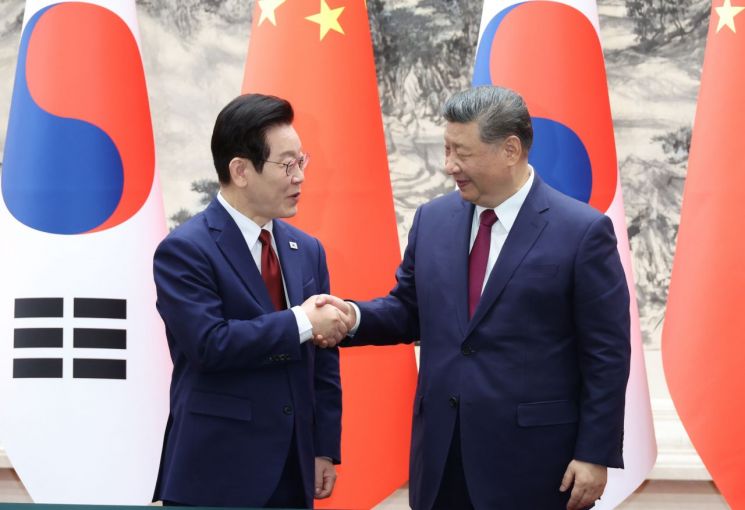
The Korean president's state visit to China was the first in about eight years since December 2017, making the meeting between the two leaders a focal point of attention. The summit, which began at 4:47 p.m. on January 5, lasted for 90 minutes, exceeding the scheduled time by 30 minutes. President Lee stated, "This will serve as an important milestone in making 2026 the inaugural year for a full restoration of Korea-China relations," and added, "I hope to open a new chapter in the development of Korea-China relations together with President Xi, keeping pace with the flow and changes of the times." President Xi responded, "China must firmly safeguard the direction of friendly cooperation with Korea," and emphasized, "We must ensure that the cooperative partnership between our two countries develops along a healthy trajectory."
President Lee also referenced the shared experience of anti-Japanese resistance in the past and proposed that the two countries open a new chapter in the development of bilateral relations. In particular, he suggested seeking feasible alternatives for peace on the Korean Peninsula. President Lee said, "Both countries should work together to contribute to peace, which is the fundamental basis for prosperity and growth."
President Xi replied, "As the international situation becomes increasingly chaotic, our two countries must inject positive energy into maintaining regional peace and promoting global development." He further stated, "With our broad common interests, we must stand on the right side of history and make correct and proper strategic choices."
The summit concluded in an overall friendly and amicable atmosphere. Following the summit, the two leaders strengthened their trust by attending a dinner together for two hours. National Security Advisor Wi Sunglak reported that the leaders continued conversations left unfinished in Gyeongju last November. During the dinner, the Chinese People's Military Band performed a total of 12 songs, with six pieces from each country. Korean songs included "Hanobaeknyeon," "Spring in My Hometown," "Doraji," and "Arirang." Among the Chinese songs was "Who Wouldn't Say Our Hometown Is Good," a hit song performed by President Xi's wife Peng Liyuan. After the dinner, President Lee posted a photo of himself taking a selfie with President Xi on social media. In a post titled "Is the picture quality clear enough?" President Lee wrote, "A selfie with President Xi and his wife using the Xiaomi phone I received as a gift in Gyeongju. Thanks to that, I got the best shot of my life, haha." Advisor Wi commented, "Following the meeting in Gyeongju, the personal relationship and rapport between the two leaders have reached another level."

Kang Yoojeong, spokesperson for the Blue House, stated, "The two leaders agreed that it is important to make the West Sea a 'sea of peace and shared prosperity' for the stable and long-term development of Korea-China relations, and they also agreed to continue constructive discussions on the issue of structures in the West Sea." After the summit, a signing ceremony was held in the presence of both leaders for 15 memorandums of understanding (MOUs) aimed at strengthening exchanges between the two countries. Korea and China signed an MOU on the establishment of a new dialogue for commercial cooperation to regularize meetings between their commerce ministers, as well as an MOU to strengthen cooperation on industrial complexes.
Meanwhile, Spokesperson Kang introduced the "pair of stone lion statues" that Korea has decided to donate to China, explaining that they are Chinese artifacts purchased in Japan in the 1930s by Jeon Hyeongpil, a renowned Korean cultural heritage protector. In China, stone lion statues are traditionally believed to ward off misfortune and bring wealth, and are typically placed at the entrance of homes or in front of tombs. Given the winter season, the statues are expected to be delivered to China around April or May.
© The Asia Business Daily(www.asiae.co.kr). All rights reserved.
![A Woman Who Jumps Holding a Stolen Dior Bag... The Mind-Shaking, Bizarre Con of a "Human Knockoff" [Slate]](https://cwcontent.asiae.co.kr/asiaresize/183/2026021902243444107_1771435474.jpg)

















