Trump Raised U.S. Tariffs by 15% Last Year
Federal Reserve Economists Analyze Historical Data
"Responding to Rising Unemployment Is More Important Than Inflation"
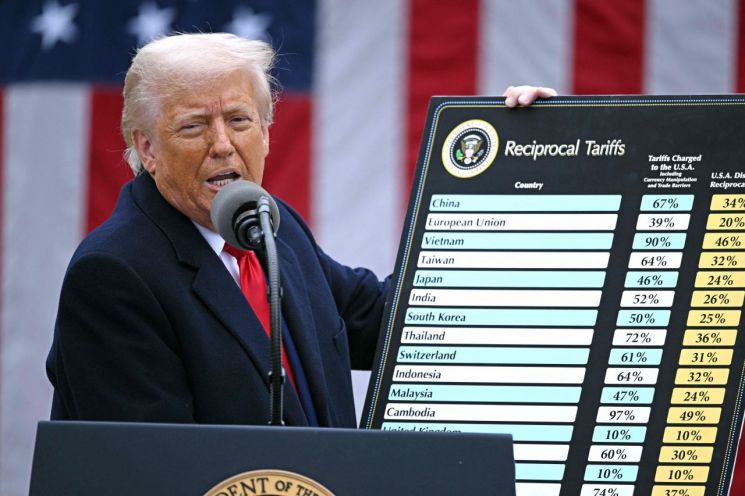 Donald Trump, President of the United States, announcing reciprocal tariffs on April 2 last year. Photo by AFP News Agency
A new study has found that the tariff policy implemented last year by the administration of U.S. President Donald Trump may not have led to sharp inflation, contrary to expectations.
Reji BarniShon, Senior Researcher, and Ayush Singh, Researcher at the Federal Reserve Bank of San Francisco, reported in the "Economic Letter" published on January 5 (local time) that an analysis of data from 1886 to 2017 showed that past tariff increases generally did not lead to higher inflation. In fact, they observed that tariff hikes tended to dampen inflationary pressures.
In April last year, President Trump declared the United States’ large trade deficit a national emergency and imposed reciprocal tariffs on various countries. Following this, the average U.S. tariff rate rose to 15%, the highest in modern history. Many economists predicted that such measures would trigger a surge in inflation, a stronger dollar, and a sharp economic slowdown.
BarniShon, one of the authors of the report, argued that "a sharp rise in tariffs increases policy uncertainty, dampens business and consumer sentiment, and leads to declines in asset prices and greater stock market volatility." This increase in uncertainty can reduce aggregate demand, which in turn could mean that deflationary pressures outweigh inflationary ones.
For this reason, from a monetary policy perspective, there is a greater need to respond to rising unemployment than to inflation. He noted, "Assuming all other conditions remain the same, if a tariff shock has little impact on inflation but leads to higher unemployment, easing monetary policy could be helpful."
This study is in line with recent findings from a research team at Northwestern University. Their analysis of data from 1840 to 2024 found that while inflation tended to rise slightly after tariff increases, the effect was very limited. The rise in import costs was offset by reduced imports and exports, as well as a decline in manufacturing activity, which decreased demand.
The Wall Street Journal commented, "This is good news, but there is also bad news," noting that both studies concluded that tariffs have a negative impact on the economy, and that the reason their effect on inflation is limited is likely because the shock weakens demand from consumers and businesses."
© The Asia Business Daily(www.asiae.co.kr). All rights reserved.
![Clutching a Stolen Dior Bag, Saying "I Hate Being Poor but Real"... The Grotesque Con of a "Human Knockoff" [Slate]](https://cwcontent.asiae.co.kr/asiaresize/183/2026021902243444107_1771435474.jpg)











