National Security Office Director Wi Sunglak: "Advanced Consensus Reached"
China Continues to Deny "Korean Wave Ban" for a Decade
As the President of South Korea made a state visit to China for the first time in eight years, there were high expectations that sensitive issues between the two countries, such as structures in the West Sea and the "Korean Wave Ban" (restrictions on Korean cultural content), would be resolved. However, no direct outcomes were achieved. Nevertheless, the two countries reached a consensus to advance future discussions.
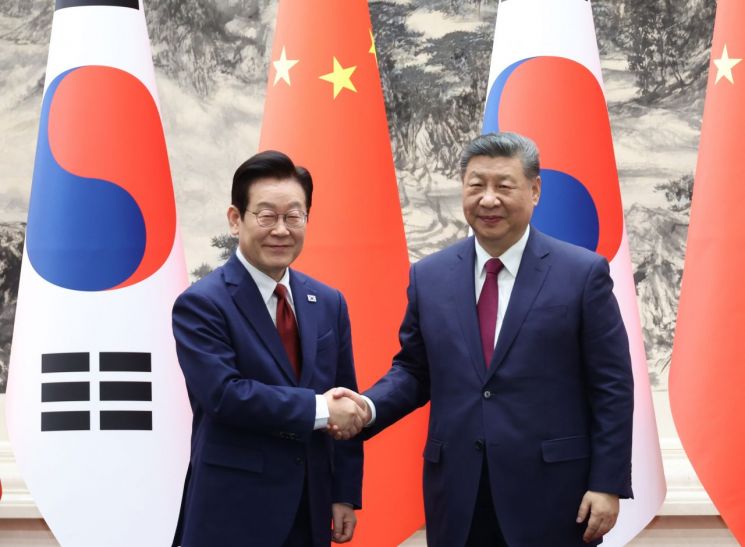 President Lee Jae-myung and Chinese President Xi Jinping shake hands at the Korea-China MOU signing ceremony held at the Great Hall of the People in Beijing on January 5, 2026. Photo by Yonhap News
The issue that drew the most attention in diplomatic circles during President Lee Jaemyung's visit to China was China's "illegal structures in the West Sea." In April, the U.S. State Department also criticized China, stating, "For decades, China has refused to comply with international law, including freedom of navigation, undermining its own economic interests and causing instability in the region." Regarding this, National Security Office Director Wi Sunglak, when delivering the results of the talks on January 5, said only that "a more advanced consensus was formed," without mentioning any substantive measures by the Chinese government.
Director Wi also stated that both sides agreed to work towards holding a vice-ministerial meeting this year on the issue of maritime boundary delimitation in the West Sea. Geopolitically, South Korea, China, and Japan, which border the West Sea and the East China Sea, all ratified the United Nations Convention on the Law of the Sea almost simultaneously in 1996 and have since continued unofficial bilateral discussions. The official consultative body for maritime boundary delimitation between South Korea and China was launched in 2014 during President Xi Jinping's visit to South Korea and began full-scale operations in 2015. However, most meetings have been at the director-general level, with only two vice-ministerial meetings ever held, the last of which was in July 2019. Meanwhile, the issue of Chinese structures in the West Sea, which began in 2020, is not directly handled by this consultative body but is discussed through separate diplomatic channels.
The "Korean Wave Ban," which has continued for a decade as a retaliatory measure against the deployment of the U.S. THAAD (Terminal High Altitude Area Defense) system in South Korea in 2016, was also raised at this Korea-China summit, but no significant progress was made. Director Wi said, "China still does not acknowledge the existence of the Korean Wave Ban itself," and added, "During the conversation, there was a lighthearted exchange suggesting that there is no need to dwell too much on whether it exists or not."
As both leaders sidestepped the resolution of sensitive issues, this visit is being evaluated as having achieved only rhetorical diplomatic significance, such as being the "first state visit of the new year" or "choosing China before Japan," with little substantive progress. Some point out that there were structural limitations from the outset, given that the meeting took place just over two months after the Gyeongju summit in November last year. Professor Park Wongon of Ewha Womans University commented, "Amid U.S.-China tensions, this state visit inevitably became a highly diplomatic and political act."
© The Asia Business Daily(www.asiae.co.kr). All rights reserved.
![Clutching a Stolen Dior Bag, Saying "I Hate Being Poor but Real"... The Grotesque Con of a "Human Knockoff" [Slate]](https://cwcontent.asiae.co.kr/asiaresize/183/2026021902243444107_1771435474.jpg)











